
DISMANTLING THE MADHAB OF THE WHITE JESUS™
“You’ve been hoodwinked! You’ve been had! You’ve been took! You’ve been led astray, run amok! This is what they do!”
— Malcolm X, Message to the Grassroots, 1963
Preface: When the Frame Becomes the Filter
Before the first line of Duʿāʾ al-Maẓlūmīn is even read, the reader is already being positioned.
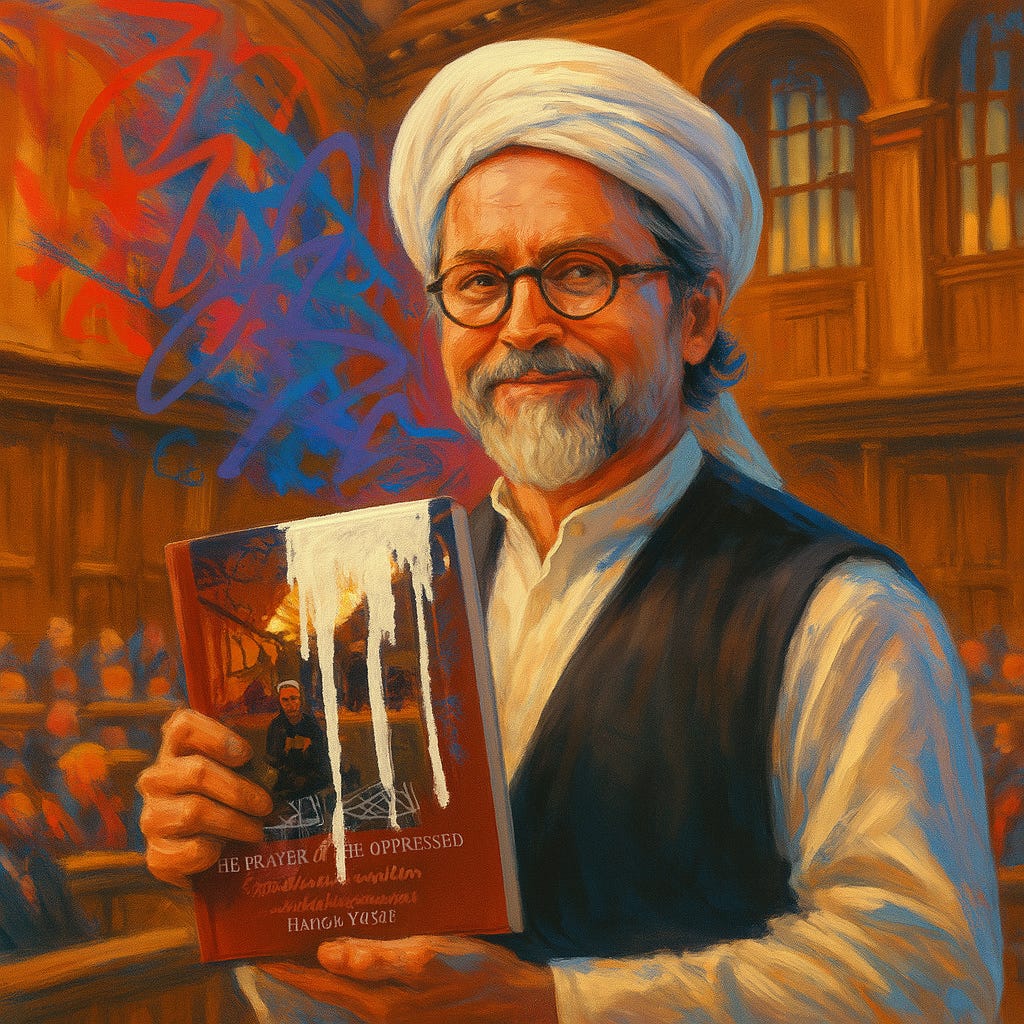
Hamza Yusuf’s introduction to the prayer includes four quotes, one from the Qur’an, one from the Prophet ﷺ, and two from white Western thinkers (St. Augustine and Friedrich Nietzsche). At first glance, they appear reflective, even profound. But taken together, they reveal the deeper betrayal: a deliberate reorientation of the duʿāʾ away from resistance and toward restraint.
The Qur’anic verse (17:33) cautions against excess in vengeance, framing the prayer as a potential danger rather than a rightful cry for justice.
The hadith reminds us to limit hostility, suggesting that the oppressed should soften their stance in case their oppressors someday become beloved.
St. Augustine pathologizes hatred, prioritizing the emotional well-being of the oppressed over their liberation.
Nietzsche, who viewed moral protest as weakness, is invoked to imply that reactive emotion is a lower spiritual form.
This is not context.
This is containment.
None of these quotes speak to the world Imam al-Darʿī lived in, nor to the world the oppressed still endure. They do not name ẓulm. They do not affirm rage. They do not echo the Qur’anic imperative to stand with the maẓlūm against the ẓālim. Instead, they disarm the reader before the prayer begins.
This is how theological laundering works.
It does not explicitly censor the duʿāʾ.
It reframes it- quietly, elegantly, and devastatingly.
A prayer born in resistance is presented in the voice of appeasement.
The White Minbar™ doesn’t always distort with force. Sometimes it does so through footnotes, formatting, and framing devices that turn liberation into lamentation.
The duʿāʾ deserves better.
So do the people who still pray it.
Duʿāʾ of the Deceived and the Dead
A Liturgy of the Unacknowledged
The first part of this essay series was - The Day the Duʿāʾ Died…
a month ago · 15 likes · 7 comments · Yusuf Jones
It was written in the wake of a realization. A reckoning with how a sacred invocation was not only appropriated, but hollowed out, softened, and returned to us shrouded in reverence and stripped of resistance.
But that was only part of the story.
Because what was done to Duʿāʾ al-Maẓlūmīn didn't begin with the release of a book. And it didn't end with weeping crowds and applause. For some of us, the betrayal had already happened, over and over, in other forms. It was already in our marrow, waiting for the next memory to make it hurt.
This part is not an analysis.
It's a memory.
A coming back.
A confrontation.
It's about what it feels like to watch the people revere the work but not the artist.
To honor the music of our living but silence the stories that made it so.
To sanctify the act while reassigning the humans.
This is the Duʿāʾ of the Deceived and the Dead, the liturgy of the unmarked, the overwritten, the staged, and the erased.
Prologue:
I was about 13, on one of our yearly visits to Memphis and our genealogical trips to the plantation and surrounding areas of Grand Junction, Tennessee. We were visiting relatives and doing research at the Ames Plantation, one of the largest and most notoriously “preserved” plantations in the state. It was during one of their annual Field Days, a kind of open house that included agricultural exhibitions and curated cultural programming. At that time, part of their programming included a performance: a choir singing old spirituals and gospel songs, some of them drawn directly from slave narratives and oral histories collected on that very land.
Only the choir wasn’t made up of descendants. Not the ones I knew. Not any family I’d ever seen at the reunions or in the records. Two-thirds of them weren’t even Black. They were professionals, curated for harmony, for performance, for presentation. And I remember walking over, hearing the voices, recognizing the melodies from the very stories my father had collected. Songs of yearning. Songs of escape. Songs of divine deliverance. But sung with polish. Sung with uniformity. Sung without the blood memory that gave them weight.
Even without terminology and political education to define what was happening to me, I knew something was wrong. I had been helping my father to edit his slide presentation and oral history display, real names, real families, real histories of the people who had lived, suffered, prayed, and died on that plantation. I had heard the tapes. I had seen the pictures. I had seen my father haggle every year with the plantation committee about whether he would be "allowed" to perform, and where they would let him take up space. And every year, I watched them push him further from the center events. Further from the "celebration." Further from the soundtrack of survival.
That moment stayed with me. And when I opened that book years later, when I saw how Duʿāʾ al-Maẓlūmīn had been packaged, polished, and presented, when I saw people weeping over it while never once naming or even knowing (or wanting to know) the people whose oppression made it necessary…
I felt it again.
When I heard non-black people testifying about how it changed their lives, how it “resonated” with them, while I, most other Black people, and a few others who understood, winced, wondered, and quietly withdrew, it became painfully clear.
These were the same people who rolled their eyes when Black Muslims shared stories of police brutality and state executions.
The same people who sighed audibly whenever Black folks asked for space to build spiritual and cultural resistance movements, or dared to form coalitions that didn’t center whiteness or immigrant respectability politics.
The same people who, in private, warned Black Muslims not to “bring up race” at spiritual retreats—especially if the esteemed editor himself was going to be present. It was considered bad adab.
Even though they were, in a sense, also being misled by the same repackaging, they were mostly already willing to disregard Black people and deny Black realities. This book—and the spiritual theater surrounding it—just gave them a pious framework to explore and expand those escapist tendencies. It gave them permission to cry without listening, to reflect without remembering, to revere without reckoning.
It was a reversed Ratatouille moment. Not a flood of childhood joy, but a tightening of the chest. A heaviness that pressed in from memory. My heart didn’t have to travel far. As the erasures mounted and the performances multiplied—as the practiced piety escalated, each reading more stylized, each event more detached from struggle—it remembered.
My heart remembered every displacement.
Every time the story was told without the people.
Every time a sacred cry was recited with no intention of responding to its call.
And the more the editor revealed himself, the more he spoke, the more he rationalized, the more he positioned himself as both victim and guide, the deeper the wound became. His “complexity” wasn’t complexity at all. It was avoidance dressed as neutrality. It was privilege masked as spiritual maturity. It was complicity varnished with Arabic calligraphy.
This is what makes the betrayal so complete.
It wasn’t just about translation.
It was about transgression.
Suffering in Display Cases – The Aestheticization of Black Pain
They didn’t steal the story.
They just preserved it.
And that’s how you know it’s worse.
Because when a thing is preserved, it’s no longer dangerous. It’s been sanitized—removed from the rhythms of the living and encased in glass for study, admiration, or pity. The plantation did not just lie about the past. It curated it. And in doing so, it neutralized it.
What I witnessed on that Field Day was not just a performance, it was a ritual. A liturgy of acceptable memory. The songs were real. The history was real. The pain they referenced was real. But the way it was framed made it safe. Digestible. Harmonized. And above all—profitable.
This is how Black pain survives in white institutions:
It is displayed, not respected.
Performed, not answered.
Aestheticized, not addressed.
And Islamic institutions have not escaped this ritual. In fact, many have refined it.
In the masjid, we are allowed to talk about Black suffering only after it has become sentimental. The ancestors are invoked, but their demands are not. The enslaved are honored, but the systems they resisted are not named. Malcolm is quoted, but his rage is explained away. Our duʿāʾs are welcome, but only if they are metaphors—not manifestos.
Saidiya Hartman calls this the afterlife of slavery. A condition where Black existence is not merely post-trauma but structured by the denial of redress. Even when suffering is acknowledged, it is often done in ways that amplify spectacle while minimizing agency. This is what she terms “scenes of subjection”, performances of suffering that make the oppressed visible only as objects of pity, never as agents of revolution.
Christina Sharpe expands this in The Wake, where she describes the oceanic weight of Black loss, how it follows us like fog, like breath, like prophecy. She writes not of slavery as an event, but as a current—an ongoing force of erasure and misrepresentation. For Sharpe, remembrance without responsibility is violence. It masquerades as care but functions as control.
So when our pain is invited into the room—when it is quoted in lectures or recited before duʿāʾ—it is not proof of progress. It may be evidence of our continued exhibition.
This is why Duʿāʾ al-Maẓlūmīn was so easily reframed. It arrived into a world already fluent in curated Black grief. A world that knows how to display our cries without ever needing to respond to them…except with more violence.
Because to truly honor that prayer would require dismantling the systems that make it necessary.
To honor that prayer would mean interrogating power, not just mourning pain.
To honor that prayer would mean reckoning with the fact that many of those leading some institutions are more invested in preserving spiritual aesthetics than in pursuing divine justice.
And so instead, the prayer is preserved.
Like the slave cabins.
Like the songs.
Like the names carved into plaques but erased from authority.
Preservation is not always a blessing.
Sometimes, it’s a casket.
The Spiritual Cost of Dislocation
There are two categories we should talk in depth about now: the deceived, and the dead.
The deceived are not merely misinformed.
They are spiritually redirected, led to believe that performance is presence, that reverence is resistance, that aesthetic proximity to pain is the same as truth.
They are the ones who cry during readings of Duʿāʾ al-Maẓlūmīn, but recoil when Black Muslims name systems of oppression.
They swoon and marvel at plantation choirs, but do not ask who was denied the mic.
They praise our survival stories, but bristle at our demand for authority.
But deception isn’t always malicious. Sometimes it’s curated. Managed. Framed. The spiritual deception we speak of here is the kind that arises when memory is staged and grief is made palatable. When the pain of others becomes your spiritual exercise, but not your political commitment.
The deceived are lulled into thinking that to witness pain is enough. That to weep at oppression is a form of resistance. That feeling is the same as allyship and fidelity.
But the duʿāʾ is not meant to just be felt.
It is meant to be followed.
It is a declaration. A reckoning. A summoning of divine attention to injustice.
And when that duʿāʾ is presented without urgency, without context, without rage, it becomes a performance. And those who partake in it as performance are not just passive. They are misled. They become spiritual consumers, deceived into believing they have stood with the oppressed when all they’ve done is attend the pain.
And then there are the dead.
Not the biologically dead, but the spiritually displaced.
The prayers that were once weapons are now decorations.
The names of the oppressed are spoken, but their descendants are erased.
The cries are archived, footnoted, and formatted until they no longer scream.
These are the dead whose blood memory has been severed.
The ones whose stories are retold, but never by them.
The ones whose pain is quoted, but whose heirs are silenced.
The ones whose duʿāʾ is recited, but whose lineage is never restored.
When we lose the line between prayer and protest, we do not only lose history, we lose divine proximity. Because the Qur’an does not honor the oppressed in metaphor. It promises them victory. It aligns with them against tyrants. It calls for justice not after the fact, but as a condition of worship.
To forget this is to suffer a spiritual death. A soft fading of the fire that once lit the path between the crushed and the Creator.
This is why the curated duʿāʾ is so dangerous.
Because even as the pain is preserved, the power is dislocated.
Even as the words remain, the witness is gone.
Even as the tears fall, the reckoning never comes.
And so we are left with an archive of petitions, disconnected from the people who made them, and hollowed out by those who found them useful but not binding.
We must speak ever more urgently and clearly now.
Because to lose a connection to the duʿāʾ is not just to lose a ritual. It is to lose an axis of alignment with God. It is to lose a station of cosmic protest, a point of orientation that tethered the crushed directly to the All-Seeing. Without that connection, we drift, collectively, theologically, and historically, into a curated exile where grief is present but power is not.
And this exile is no accident.
It has architects.
The most dangerous distortions of our era do not arrive through brute force. They arrive through framing. Through scholars who dress betrayal in respectability. Through editors who redact confrontation and call it commentary. Through footnotes that function like chloroform, subduing the duʿāʾ, rendering it still, esculent, non-threatening.
Hamza Yusuf’s publication of Duʿāʾ al-Maẓlūmīn is not merely disappointing, it is a textbook case of Taghūtic laundering.
Not just because he introduced Western thinkers. Not just because he added commentary. But because he reconstructed the entire spiritual posture of the prayer, away from divine indictment and toward domesticated lament. He transformed the prayer’s intended alignment with the oppressed into a vague call for “restraint,” a gesture that, in effect, upholds the very structures of injustice the duʿāʾ was meant to defy.
This is not neutrality.
This is displacement with a prayer bead in hand.
He did not faithfully or fully transcribe or translate Imam al-Darʿī’s fire. He repackaged it. He smothered its flame beneath a quilt of pre-emptive forgiveness, misapplied mercy, and a dangerous preoccupation with the potential discomfort of the powerful. The maẓlūm becomes a poetic figure, not a witness in the court of the Most Just. And the ẓālim? He is not named. He is spiritualized. Absorbed into a cycle of moral abstraction so effectively that resistance itself becomes suspect.
This is not the Sunnah of the Prophet ﷺ.
This is not the duʿāʾ of Bilāl.
This is not the theology of the oppressed.
These are the disciples of the Madhab of the White Jesus™.
The builders of the White Minbar™.
The spiritual engineers of sanctified surrender.
They do not simply misinterpret the tradition.
They renovate it in their image.
They elevate restraint over justice, etiquette over alignment, and performance over prophetic fire.
They build platforms where whiteness is unspoken but central.
They publish prayers made inert.
They train followers to fear confrontation and call it spirituality.
They reward silence and brand it wisdom.
They erase the maẓlūm from the duʿāʾand replace them with an imagined self—wounded, reflective, emotionally moved, but never accountable.
This is not sacred transmission.
This is theological trespassing.
This is the Ṭarīqah of Ṭāghūt™.
A path disguised as piety.
A spirituality that protects oppressors by pacifying the oppressed.
A discipline of domesticated duʿāʾ and empire-friendly ethics.
And it is followed not only by the deceived, or the departed,
But by disciples who know exactly what they’re building.
Because they no longer tremble at injustice or before Divine balance and empathy.
Because they’ve confused reflection for resistance.
Hamza Yusuf did not dare kill the duʿāʾ.
He couldn’t.
But he embalmed it.
He placed it in a glass case and called it preservation.
He stripped it of its immediacy, its sacred ancestral legacy, its God-ordained resistance, and then handed it back to the community like a gift.
But it was a gift with the power and potency removed.
And that is not a gift.
That is desecration.
Performance of Reverence, Practice of Exclusion
It is one thing to betray a prayer.
It is another to build a platform around that betrayal.
What we face now is not merely a theological distortion, but an institutional choreography—a whole infrastructure of reverence that performs solidarity while enforcing exclusion. A system that honors the oppressed in word but refuses them voice, access, power, or presence.
This is not an accident.
It is design.
In this system, Black Muslims are welcome at the table, only if they don’t flip it over. They are featured in programs, invited to panels, asked to perform grief or forgiveness, but never given the authority to redefine the conversation. Never asked to lead the theological critique. Never trusted with the mic unless their words are already known to be safe.
This is how the White Minbar™ operates.
It invites proximity, but punishes the centering of the Prophetic.
It raises and amplifies voices that will not indict hatred of evil, but instead inspire erasure, displacement, and the denial of humanity.
It curates illusions and tokenizations of diversity to insulate against dissent, not to elevate truth.
It selects speakers who will leave power unnamed.
It rewards fluency in emotional resonance, but not in theological resistance.
You may be included, but only if you do not interrupt.
You may recite duʿāʾ, but not direct it.
You may recall suffering, but not issue summons against the systems and sycophants who prolong it.
This is not inclusion.
This is containment.
You can see it in the events where Duʿāʾ al-Maẓlūmīn is recited by candlelight but never connected to ICE raids, police killings, settler colonialism, or the surveillance of Muslim Black youth. You can feel it when Hamza Yusuf is flown in, again and again, to interpret a cry he helped neutralize, hosted not despite his distortion of the prayer, but because of it.
This is how reverence is weaponized.
Not to liberate.
To manage.
And this performance has its rules:
You may speak about pain, but not its political causes.
You may name trauma, but not name those who benefit from its ongoing erasure.
You may quote Malcolm, but only if you stop before he says “by any means necessary.”
You may invoke the Prophet ﷺ—but only the parts that can be read at interfaith banquets.
In this curated ecosystem, duʿāʾ becomes theater, and duʿāʾ leads become hosts. The ones who are permitted to teach the prayer are those who were never meant to inherit it. Those who once stood against this kind of spiritual betrayal now find themselves erased from their own traditions, or worse, invited only to play supporting roles on someone else’s stage.
And the stage is well-lit.
It includes:
Publishers who push the rebranded duʿāʾ while rejecting manuscripts and tafsir that name empire.
Institutions who ask Black Muslims to “speak about justice,” but edit the part where they indict the white supremacy of the institution itself.
Spiritual retreats where race is only and ever discussed after someone has been harmed, and even then, behind closed doors.
Conferences that host scholars who will lead aesthetically comforting discussions about anything but their performative piety.
Sacred poetry workshops that urge participants to the explore themes of Prophetic grief and loss without platforming those who have actually lost lives and been grieved by oppression.
Funders who will finance your grief, but never your resistance.
This is institutional Taghūt on a prayer rug.
This is spiritual apartheid in the age of curated inclusion.
This is how a prayer is domesticated by platforms that never intended to liberate—only to preserve power while appearing devout.
So when people ask,
“How could this prayer be betrayed?”
“How could so many accept the softened version?”
The answer is simple:
Because it was not just accepted.
It was platformed.
Promoted.
Packaged.
Endorsed.
Made respectable.
Because a prayer that indicts is a threat.
But a prayer that performs is an asset.
And in this system, spiritual assets are leveraged for likes, not liberation.
Revisiting the Introduction as a Quietist Framework for Spiritual Disarmament
If the curated epigraphs disarmed the reader’s heart before the prayer began, then Hamza Yusuf’s full introduction functions as a quietist sermon disguised as scholarship, a masterclass in literary incarceration that slowly shifts the purpose of the duʿāʾ from supplication against injustice to self-blame within injustice.
Let us be clear: what appears to be a deeply reflective essay on power, sin, and the nature of man is, in fact, a slow but deliberate displacement of the oppressed from the center of the prayer.
This is not an introduction.
It is a reframing.
A theological repositioning of who we are allowed to become when we open this book.
1. The Natural Order as Moral Template: From Resistance to Submission
The introduction begins by lauding the perfection of nature:
“Beasts of prey take only what they need to survive from weaker ones… all living together… in a world of harmony and mutual understanding.”
This is the first sleight of hand. It is the invocation of natural balance as moral baseline, used here to precondition the reader for a world where hierarchy is unproblematic as long as it reflects divine order.
In doing so, Yusuf implies that the real issue is deviation from divine symmetry, not systemic power. The world is good, he suggests, until man’s base desires distort it.
The problem is not oppression, then.
The problem is excess.
Once again, the lens is shifted inward before the reader even has a chance to hear the cry of the oppressed.
2. Sin as Universal Mirror: The Erasure of the Ẓālim-Maẓlūm Binary
This terribly Taghutic framework deepens with repeated claims that everyone is both oppressor and oppressed:
“A little bit of the tyrant exists in all of us.”
“We are all oppressors, and we are also oppressed.”
This reprehensible moral flattening, presented as spiritual introspection, is actually a systematic erasure of the Qur’anic binary between ẓālim and maẓlūm. Rather than affirming the sacred alignment with the crushed, Yusuf insists that we must first look inward to find our own complicity before speaking against injustice.
But this is not the method of the Qur’an.
The Qur’an names the tyrants.
The Qur’an sides with the oppressed.
The Qur’an reveals a divine preference—not neutrality.
By trying to make us all equally guilty, Yusuf neutralizes the duʿāʾ’s powerful moral trajectory. The prayer becomes a cracked mirror, not a shining sword.
The reader is not trained to join the oppressed, but to question whether they are allowed to critique at all.
3. Piety as Obedience; Never, Ever Confrontation
Throughout the introduction, Yusuf repeats the refrain of divine trust, submission, and the limits of critique:
“We are possessions of God, and one does not question the actions of any owner regarding his possessions.”
“We are not to object, only to understand.”
“Even in calamities, we must praise.”
But this is not how the Prophets ﷺ responded.
They wept.
They raised their hands.
They demanded.
They resisted Pharaohs, Nimrods, tyrants, and hypocrites.
Yusuf strips the duʿāʾ of its Qur’anic function as protest against injustice and replaces it with metaphysical acquiescence. The prayer no longer carries divine confrontation, it carries interior refinement. And that is the core of the betrayal.
This is not duʿāʾ as weapon.
This is duʿāʾ as therapy for privileged posturing.
4. Revenge, Resentment, and the Fear of Prophetic Rage
Perhaps the most revealing rhetorical device is Yusuf’s repeated pathologizing of anger:
“Revenge is a desire for healing.”
“Resentment is dissatisfaction with God.”
“Anger is a sign of spiritual immaturity.”
What, then, becomes of the maẓlūm who cries out in rage?
What becomes of the child who watches her father lynched, or the woman brutalized by occupation?
According to this framework, her rage is not sacred—it is suspect.
Her grief must be managed.
Her duʿāʾ must be contained.
And any desire for justice must be passed through a filter of personal purification before it is considered valid.
This is not mercy.
This is theological gentrification.
5. Prophetic Narratives Distorted by Quietism
Yusuf invokes the Prophet ﷺ again and again, but selectively. He emphasizes the Prophet’s patience, mercy, and refusal to curse, while omitting the Prophet’s rebuke of tyrants, prayers for divine punishment, and his sword unsheathed in the face of empire.
Nowhere does Yusuf mention:
The Prophet’s ﷺ explicit duʿāʾ against Qurayshi oppressors by name
His raising of arms against systematic violence
His refusal to spiritually normalize injustice through metaphysical surrender
Instead, the Prophet ﷺ is rendered as a figure of non-confrontational grace, a sage, not a statesman. The model given to the reader is not the Prophet of Uhud, Khandaq, or Fath Makkah, it is a Prophet carefully selected to support a theology of deference and domestication.
This is not Sunnah.
This is suppression in prophetic clothing.
6. The “Real Work” is Self-Blame
The final rhetorical manipulation is the most dangerous.
After three dozen pages, Yusuf ends by calling us away from structural analysis and into self-blame:
“If we find ‘other than good’ in the world, we are missing something fundamental to our faith.”
“We are the reason for the cycle of oppression.”
“We must purify our own souls before seeking justice.”
This is the replacement theology.
Where the Qur’an calls us to fight the ẓālim, this calls us to question our own audacity.
Where the Prophet ﷺ aligned with the downtrodden, this urges us to remain silent so as not to spiritually misstep.
Where duʿāʾ is supposed to shake the throne of oppression, this makes it a whisper in a mirror-lined room.
The final result?
A prayer with perfect Arabic.
A body of scholarly commentary.
A quiet heart.
And a silenced world.
The Hadith That Breaks the Frame
And yet, even after all the epigraphs, formatting, introductions, poetic gestures, citations, and moral detours—there remains one voice that none of it can drown out:
“Beware the duʿāʾ of the oppressed, for there is no barrier between it and Allah—even if the oppressed is a disbeliever.”
(Sahih narration; reported in Musnad Aḥmad, Bukhārī’s Adab al-Mufrad, and elsewhere)
There is no condition in this hadith.
No requirement for forgiveness.
No test of inner calm.
No purification of the soul.
No ideological checklist.
Not even explicit declarations of belief.
The cry of the oppressed does not ask for permission.
It does not wait for context.
It does not beg for literary framing.
It breaks through.
This is the terror Hamza Yusuf’s introduction sought to neutralize.
Because if this hadith is true—and it is—then everything his introduction constructed falls apart:
The restraint is irrelevant.
The spiritualized blame is irrelevant.
The literary elegance is irrelevant.
The metaphysical surrender is irrelevant.
The prayer does not need him.
The oppressed do not need him.
The duʿāʾ rises with or without editorial approval.
This single hadith, spoken from the mouth of the Messenger of God ﷺ, annihilates the entire architecture of curated patience and self-blame Hamza attempted to erect around the prayer.
This is the difference between the Prophetic tradition and its performance.
One empowers. The other polices.
One says: Cry out.
The other says: First, calm down.
But the Prophet ﷺ gave the maẓlūm no such warning.
He gave the ẓālim one:
“Beware…”
This is not commentary.
It is confrontation.
It does not ask you to reflect.
It demands that you listen.
And it does not speak to the oppressed.
It speaks to their oppressors—and to all who sanitize, explain away, or curate their pain.
This is the cry that Br. Mark Hanson tried to contain under the guise of Shaykh Hamza.
Not with erasure, but with elegance.
Not with censorship, but with serenity.
Not by denying the duʿāʾ- but by redefining what makes it worthy.
And so we say, now and finally:
We reject that frame.
We reject the footnotes and formatting.
We reject the literary polishing of a divinely directed scream.
We reject the demand for politeness before pain.
We reject the theology that places purity before protest, and self-blame before sacred confrontation.
This prayer was never meant to be beautiful.
It was meant to be heard in heaven.
It was meant to terrify tyrants.
It was meant to threaten empires.
It was meant to break hearts—and open the sky.
The duʿāʾ of the maẓlūm does not ask to be refined.
It asks to be remembered.
Rejoined.
Resurrected.
It was never dead.
Only buried under layers of literary performance, spiritual self-policing, and a refusal to trust the scream of the crushed.
But the duʿāʾ remembers itself.
It remembers Us.
It carries the voice of every child whose mother’s wails were ignored.
Every father disappeared behind bars.
Every ancestor left in the sea with no grave but the memory of the angels.
Every lineage stripped of the right to cry aloud.
We say to those who perform reverence while enforcing exclusion:
You cannot contain this cry.
You cannot control what heaven already hears.
You cannot manage what the Prophet ﷺ warned you about.
You cannot curate divine wrath.
You cannot rewrite a duʿāʾ that was never yours.
So we unarchive it.
We speak it without restraint.
We place the maẓlūm back at the center—not just as a victim, but as the rightful inheritor of prophetic proximity.
We say:
This prayer does not belong to publishers.
This prayer does not belong to platforms.
This prayer does not belong to polite religion.
This prayer belongs to those who cried it first, and those who still cry it now.
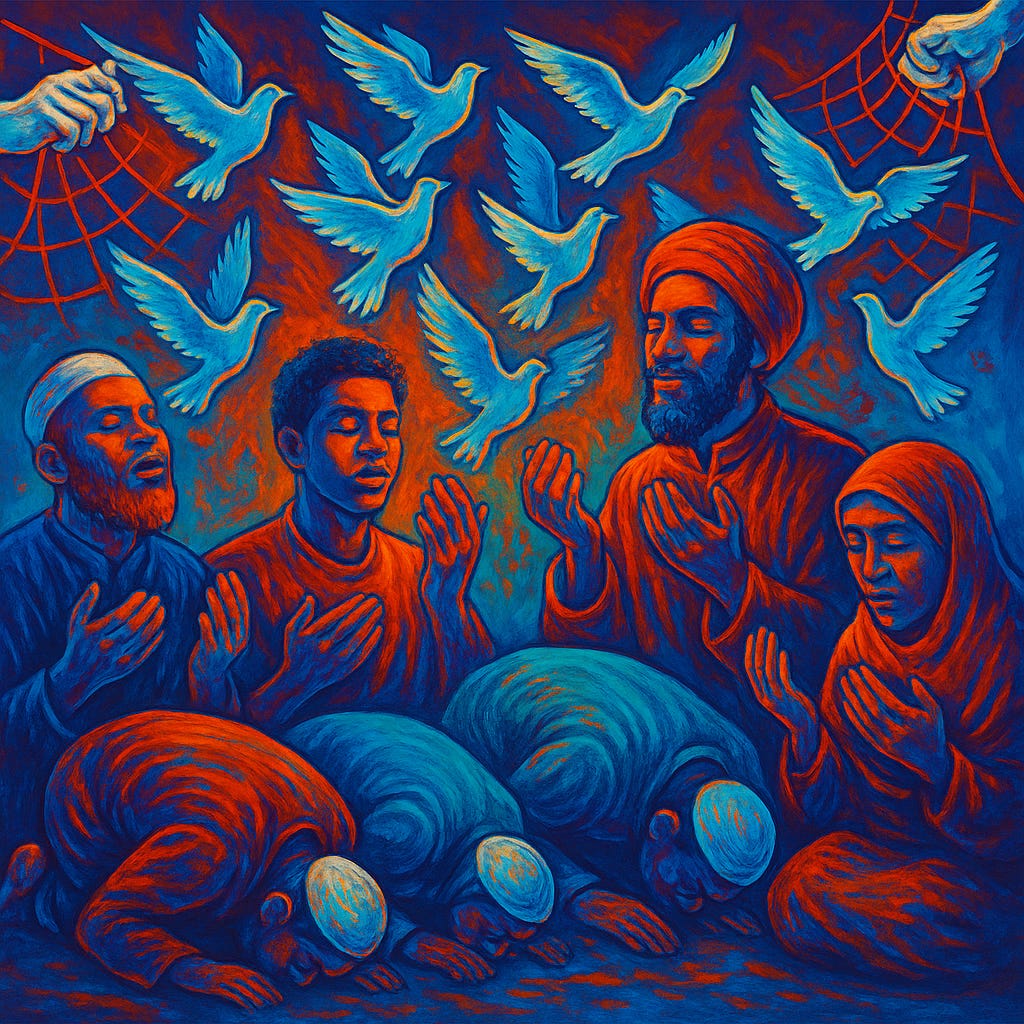
And we, we who descend from the drowned, the disappeared, the displaced, the defiant—
We are its heirs.
Epilogue: Toward Reclamation
What you’ve read is not the end of the duʿāʾ’s betrayal.
It is the naming of the betrayal.
And naming is only the first act of justice.
What comes next is not a response to Hamza Yusuf.
It is a response to God—to the sacred legacy of duʿāʾ as a weapon of the oppressed, as a trust handed down through pain, blood, and revelation.
Part Three will not be polite.
It will not offer compromise.
It will not ask permission.
It will reclaim the duʿāʾ in the name of those it was stolen from.
It will restore the voice of Imām Muḥammad b. Nāṣir al-Darʿī to its proper station—not as a spiritual ornament, but as a descendant of divine rage and resistance.
And it will do what the White Minbar™ fears most:
Reject the framing. Reassert the fire. Restore the lineage.
The duʿāʾ of the oppressed is not up for reinterpretation.
It is up for return.
We are not asking for space.
We are taking back the voice.
The next chapter is not about what they did.


No comments:
Post a Comment