Thursday, 31 July 2025


Majlis Ugama Islam Singapura 

Khutbah Jumaat 

1 Ogos 2025 / 7 Safar 447H

Panduan Iman Dalam Menghadapi Tekanan

Sidang jemaah yang dirahmati Allah,  

Suburkanlah hati kita dengan sifat takwa. Ketakwaan yang membuahkan kecintaan Allah ke atas kita, dan terhindarnya kita daripada kemurkaan-Nya. Semoga kita dikurniakan kelapangan hati dan ketetapan iman dalam mengharungi liku-liku kehidupan. 


Sidang jemaah yang dikasihi Allah, 

Bolehkah seorang mukmin mengalami tekanan dan keresahan (stres)? Jika ini berlaku, adakah ia menandakan kelemahan iman? Untuk menjawab soalan ini, ayuh kita mengambil iktibar daripada kisah ibunda Nabi Isa a.s., iaitu Maryam a.s. 

Di dalam Al-Quran, Allah s.w.t. menggambarkan Maryam a.s. sebagai wanita yang tinggi martabatnya, disebabkan pengabdiannya kepada Allah. Beliau dipilih, disucikan, dan dimuliakan, lebih daripada seluruh wanita di seluruh alam. 

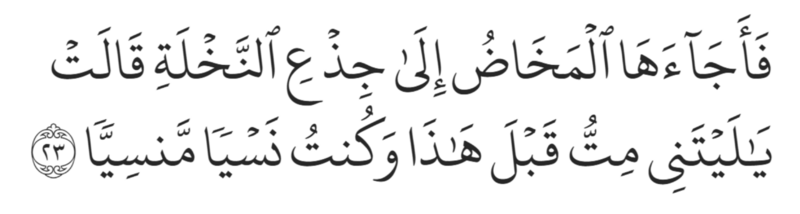
Namun, kisah Maryam a.s. tidak sunyi daripada ujian yang menghimpit jiwa. Beliau sarat mengandung tanpa sosok suami, kemudian melahirkan seorang bayi lelaki, sementara dihujani cemuhan masyarakat yang mengguris hati. Sehinggakan, keluhannya dirakamkan di dalam Surah Maryam, ayat ke-23: 

Yang bermaksud: "(Ketika ia hendak bersalin) Maka kesakitan untuk melahirkan itu memaksanya bersandar pada pangkal sebatang pohon kurma, lalu ia berkata: 'Alangkah baiknya kalau aku mati sebelum ini, dan aku menjadi sesuatu yang dilupakan.'"


Sidang hadirin sekalian,

Kisah Maryam a.s. menunjukkan kepada kita bahawa tekanan dan keresahan adalah lumrah dalam kehidupan insan. Setiap manusia akan mengalaminya, dan ia bukanlah tanda kelemahan iman

Setiap cabaran menguji bagaimana kita mengurus dan mengatasi tekanan, dengan berpaksikan iman. Sebagai mukmin, selain menjadi kewajiban individu, kita wajar melihat ini sebagai fardu kifayah. Yakni, kita saling membantu saudara kita mengatasi tekanan


Saudaraku,  

Kehidupan kita hari ini penuh dengan cabaran yang boleh mengundang tekanan. Antara lain, gaya hidup yang dipengaruhi anasir yang pelbagai, sehingga menimbulkan kecelaruan identiti dan agama, khususnya di kalangan anak muda. Begitu juga, persoalan nafkah dan kos sara hidup yang tinggi, terutama bagi mereka yang bergelar ibu bapa tunggal. Ketidakstabilan politik dunia yang menjejaskan ekonomi dan menyebabkan ramai hilang pekerjaan. Hal ini menimbulkan tekanan mental kepada mereka yang terkesan. 

Tren ini menyebabkan sebahagian saudara kita, mencari jalan yang mereka anggap dapat mengurangkan tekanan yang dihadapi. Kadangkala, jalan yang dipilih boleh memburukkan keadaan. 

Sebagai contoh, menjadi perbincangan hari ini, hasil kajian yang menunjukkan kaitan yang jelas antara gejala penggunaan vape dengan peningkatan kadar tekanan yang kronik, dan kemerosotan tahap kesihatan mental. Seseorang yang menghadapi tekanan mungkin memilih untuk merokok atau menggunakan vape, malah Kpod, untuk mengurangkan atau menghilangkan tekanan tersebut.  Namun, ia mungkin sahaja terjebak kepada masalah tekanan dan stres yang lebih buruk, yang memudaratkan kesihatan mental dan fizikal. 

Saudara, apa sahaja bentuk ujian dan tekanan yang dihadapi, sokongan keluarga dan mereka di sekeliling amat penting. Ia menuntut kepekaan dan tindakan bersama, sebagai tanda amanah dan ihsan. Kita tidak boleh membiarkan mereka yang sedang diuji, keseorangan dalam mengatasi ujian

Maka apakah pengajaran daripada kisah Maryam a.s. yang boleh kita terapkan dalam menghadapi ujian? 

Pertama: Di sebalik kesusahan, pasti ada hikmah dan pengajaran. 

Ujian kehidupan pasti ada pengajarannya, walaupun kita belum memahaminya. Seperti Maryam a.s., sebuah ujian boleh berubah menjadi pengalaman yang membentuk peribadi, malah menjadi legasi. Misalnya, ada di kalangan bekas banduan yang kini bangkit dan membantu mereka yang masih terperangkap dalam kancah yang sama. Dengan berbekalkan sifat cekal dan ikhlas, kegelapan dan kepayahan yang dilalui hari ini, boleh menjadi penyuluh bagi diri dan orang lain di masa hadapan. 

Kedua: Hulurkan dan dapatkan sokongan. 

Benar, sebagai mukmin, kerohanian kita adalah sumber kekuatan dan benteng pertama. Namun, kerap kali, tekanan memerlukan pendekatan menyeluruh, termasuk aspek fizikal, emosi, psikologi, dan sosial.  

Rasulullah s.a.w. sendiri mencari ketenangan di sisi Sayyidatina Khadijah r.a. ketika dibelenggu kegusaran. Cuba bayangkan, sekiranya Maryam a.s. mendapat sentuhan kasih dan sokongan daripada masyarakat sekeliling, tidakkah yang demikian boleh mengurangkan tekanannya

Oleh itu, penting untuk kita mencari, dan menjadi, sumber sokongan. Dapatkan bantuan profesional. Jangan biarkan seseorang menghadapi tekanan secara bersendirian. 


Sidang jemaah yang dirahmati Allah,

Kita perlu membina masyarakat yang peduli dan menyantuni. Masyarakat yang mendengar sebelum menasihati. Yang menekankan aspek rohani, namun juga bersedia menggunakan pendekatan menyeluruh, disulami empati. 

Semoga kita dapat meneladani kekuatan Maryam a.s. dalam mengatasi tekanandan kepayahan. Semoga kita juga tergolong di kalangan mereka yang menyebarkan harapan, menitip kekuatan, agar kita juga sentiasa mendapat rahmat dan bantuan Tuhan. Amin, ya Rahman ya Rahim. 


Khutbah Kedua

 ☆Tadabbur Kalamullah 6 Safar 1447H☆


یَسۡـَٔلُونَ أَیَّانَ یَوۡمُ ٱلدِّینِ 


Mereka bertanya (secara mengejek): "Bilakah datangnya hari pembalasan itu?"


یَوۡمَ هُمۡ عَلَى ٱلنَّارِ یُفۡتَنُونَ 


(Jawabnya: hari itu ialah) hari mereka diseksa (dengan dibakar) atas api neraka" [Surah az-Zhāriyāt 12-13]


#Golongan yang engkar, lalai lagi bodoh itu bertanya-tanya bilakah terjadinya hari kiamat itu seolah-olah mereka tidak percaya akan kedatangannya. Apabila diberitahu tentang hari kiamat maka mereka bertanya: “bila, bila?”. Akan tetapi pertanyaan mereka itu adalah untuk mempersenda-sendakan sahaja, bukannya hendak tahu dan insaf.


#Inilah persoalan mereka semasa di dunia kerana hati mereka sendiri tidak mahu menerima kebenaran sejak awal lagi. 


#Allah swt beritahu bilakah hari kiamat itu akan berlaku iaitu pada hari mereka akan dipanggang di dalam api neraka!!. Allah swt tidak beritahu ‘bila’ ia akan terjadi, tetapi ‘apa’ yang akan terjadi. Ini adalah untuk menakutkan mereka (dan menyedarkan mereka) bahawa mereka yang tidak beriman kepada Allah swt akan menjadi bahan bakaran api neraka.


#Kalimah يُفتَنونَ dari ف ت ن yang asalnya bermaksud emas yang dicairkan untuk diasingkan daripada bendasing dan logam lain, maka begitulah mereka akan dibakar nanti. Maksudnya mereka akan dibakar dalam api neraka sepertimana emas itu dibakar. Kesengsaraan yang maha dahsyat akan dikenakan kepada mereka. Lalu Allah swt berfirman kepada mereka:


ذُوقُوا۟ فِتۡنَتَكُمۡ هَـٰذَا ٱلَّذِی كُنتُم بِهِۦ تَسۡتَعۡجِلُونَ 


(Sambil dikatakan kepada mereka): "Rasalah azab seksa yang disediakan untuk kamu; inilah dia yang dahulu kamu minta disegerakan kedatangannya" [Surah az-Zhāriyāt 14]


#Dikatakan kata-kata pedas ini sebagai azab rohani. Sudahlah fizikal mereka sedang diseksa, ditambah pula dengan kata-kata yang menyakitkan hati dan meruntun jiwa. Azab dari sudut ini menyebabkan tekanan psikologi kepada ahli neraka dan menambahkan kesengsaraan zahir dan batin. 


#Rasalah azab fitnah yang dulunya mereka tanya-tanya dan minta disegerakan. Dulu mereka tanya bila, bila… dan berlagak konon minta disegerakan azab kalau memang benar ada Kiamat itu?


#Mereka minta disegerakan kerana mereka tidak percaya.  Kalau ada azab itu, mohon disegerakan!. Mereka tidak faham bahawa Allah swt tidak terus seksa dan matikan mereka adalah kerana hendak memberi peluang kepada mereka untuk ubah perangai dan beriman dengan bersungguh-sungguh. Oleh kerana Allah swt sayang kepada mereka, maka Allah swt beri peluang kepada mereka. Namun tatkala peluang ini diabaikan, maka azab yang akan menjahanamkan mereka. 


♡Takutlah akan azab Allah swt. Jangan sesekali merasakan azab Allah itu hanya biasa-biasa. Ketahuilah bahawa azab Allah itu tersangat luar biasa dan tersangat ngeri serta pedih♡


🐊Ust Naim

Telegram Channel

Klik link ini untuk join:

http://bit.ly/tadabburkalamullah


Facebook Page:

https://m.facebook.com/tadabburkalamullah


 PERKONGSIAN 1 HARI 1 HADIS


Zikir Ketika Menerima Musibah


عَنْ أُمِّ سَلَمَةَ قَالَتْ: قَالَ رَسُولُ اللَّهِ صَلَّى اللَّهُ عَلَيْهِ وَسَلَّمَ:  مَا مِنْ مُسْلِمٍ تُصِيبُهُ مُصِيبَةٌ فَيَقُولُ مَا أَمَرَهُ اللَّهُ بِهِ: إِنَّا لِلَّهِ وَإِنَّا إِلَيْهِ رَاجِعُونَ اللَّهُمَّ أَجِرْنِي فِي مُصِيبَتِي وَاخْلُفْ لِي خَيْرًا مِنْهَا إِلَّا أَخْلَفَ اللَّهُ لَهُ خَيْرًا مِنْهَا. فَلَمَّا مَاتَ أَبُو سَلمَة قَالَت: أَيُّ الْمُسْلِمِينَ خَيْرٌ مِنْ أَبِي سَلَمَةَ؟ أَوَّلُ بَيْتِ هَاجَرَ إِلَى رَسُولِ اللَّهِ صَلَّى اللَّهُ عَلَيْهِ وَسَلَّمَ ثُمَّ إِنِّي قُلْتُهَا فَأَخْلَفَ اللَّهُ لِي رَسُولُ اللَّهِ صَلَّى اللَّهُ عَلَيْهِ وَسَلَّمَ


Daripada Ummu Salamah RA, beliau berkata: Rasulullah SAW bersabda: Tiada seorang Muslim pun yang ditimpa musibah, lalu dia mengucapkan sebagaimana yang diperintahkan Allah: ‘Innā lillāhi wa innā ilayhi rāji‘ūn (Sesungguhnya kami milik Allah dan kepada-Nya kami kembali),

Ya Allah, berilah ganjaran kepadaku dalam musibahku ini dan gantikanlah untukku sesuatu yang lebih baik daripadanya’), melainkan Allah akan menggantikannya dengan sesuatu yang lebih baik daripadanya. Ummu Salamah berkata: Ketika Abu Salamah (suaminya) meninggal dunia, aku berkata (dalam hati): “Siapakah di kalangan kaum Muslimin yang lebih baik daripada Abu Salamah? Beliau adalah orang pertama yang berhijrah ke Rasulullah.” Namun aku tetap mengucapkannya (doa tersebut), lalu Allah menggantikannya untukku dengan Rasulullah SAW (yakni, Nabi SAW mengahwini Ummu Salamah). (HR Muslim No: 918) Status: Hadis Sahih


Pengajaran:


1.  Musibah adalah ujian kehidupan. Islam tidak melarang berduka, tetapi menuntut kita menghadapinya dengan sabar, redha dan doa.


2.  Rasulullah SAW menganjurkan untuk mengucapkan zikir ini jika ditimpa musibah (kematian, kehilangan, kesakitan).


إِنَّا لِلَّهِ وَإِنَّا إِلَيْهِ رَاجِعُونَ اللَّهُمَّ أَجِرْنِي فِي مُصِيبَتِي وَاخْلُفْ لِي خَيْرًا مِنْهَا


Maksudnya: Sesungguhnya kami milik Allah dan kepada-Nya kami kembali), Ya Allah, berilah ganjaran kepadaku dalam musibahku ini dan gantikanlah untukku sesuatu yang lebih baik daripadanya’


3.  Zikir dan Doa yang diajarkan Rasulullah SAW ini mengajar kita bahawa redha dengan qada' dan qadar Allah serta berdoa adalah tanda iman dan kekuatan jiwa.


4.  Contohilah kehidupan Ummu Salamah RA, beliau kehilangan suami tercinta iaitu Abu Salamah namun beliau tetap Redha dan membaca doa seperti yang diajarkan Nabi SAW. Akhirnya  Allah gantikan dengan sesuatu yang tidak disangka-sangka iaitu menjadi isteri kepada Rasulullah. 


5.  Ikhlas menghadapi ujian akan dibalasi dengan ganjaran besar  yang lebih baik. Kadangkala Allah ganti dengan ketenangan hati, pahala besar, atau kedudukan mulia di akhirat.


#BangunkanJiwaTaqwa

#TeguhkanUkhuwahSebarkanRahmah

#BinaNegaraRahmah

#PertubuhanIKRAMMalaysiaNegeriJohor

#PalestinMerdeka


06hb Safar 1447H

31hb Julai 2025


Utk dapatkan 1 Hari 1 Hadis Pertubuhan Ikram Malaysia Negeri Johor, sila klik link di bawah :

telegram.me/hadisharian_ikram


Wednesday, 30 July 2025

 ☆Tadabbur Kalamullah 5 Safar 1447H☆


وَكَمۡ أَهۡلَكۡنَا قَبۡلَهُم مِّن قَرۡنٍ هُمۡ أَشَدُّ مِنۡهُم بَطۡشࣰا فَنَقَّبُوا۟ فِی ٱلۡبِلَـٰدِ هَلۡ مِن مَّحِیصٍ 


"Dan berapa banyak kaum-kaum (yang ingkar) yang terdahulu daripada orang-orang musyrik Makkah itu Kami telah binasakan. Kaum-kaum itu lebih kekuatannya (dan kehandalannya) daripada mereka, lalu kaum-kaum itu keluar mencari perlindungan di merata-rata negeri. (Meskipun demikian keadaannya) dapatkah (mereka) menyelamatkan diri?" [Surah Qāf 36]


#Allah swt ingatkan kepada kita semua bahawa Allah swt boleh timpakan azab kepada sesiapa yang mengingkariNya ketika di dunia lagi, tidak perlu tunggu balasan di akhirat. Dan memang banyak sekali umat-umat penentang tauhid yang terdahulu (dikalangan umat sebelum Nabi Muhammad saw) daripada golongan musyrikin Mekah yang telah dibinasakan. Dan sebahagian mereka telah disebut dalam al-Quran.


#Kaum-kaum terdahulu yang menentang dakwah para Rasul sebelum Nabi saw telah dimusnahkan itu hebat-hebat belaka. Lebih hebat dari golongan Musyrikin Mekah tetapi mereka dihancurkan juga. Allah swt hendak ingatkan kepada Musyrikin Mekah bahawa ada lagi yang lebih hebat, gagah dan kuat dari mereka yang telah dimusnahkan.


#Maka janganlah merasakan yang mereka akan selamat. Golongan Musyrikin Mekah itu jangan perasan mereka hebat dan bijak. Tidak ada apa-apapun kalau dibandingkan dengan umat terdahulu sebelum mereka. Umat sebelum mereka lebih besar dan kuat fizikalnya, lebih hebat kemewahan hidupnya, lebih pakar dalam teknologinya dan lebih segala-galanya daripada orang Mekah. 


أَلَمۡ تَرَ كَیۡفَ فَعَلَ رَبُّكَ بِعَادٍ 


"(Kami tetap akan membinasakan orang-orang yang menentangmu wahai Muhammad), tidakkah engkau perhatikan, bagaimana Tuhanmu telah melakukan terhadap kaum Aad (yang kufur derhaka)"


إِرَمَ ذَاتِ ٱلۡعِمَادِ 


"Iaitu penduduk "Iram" yang mempunyai bangunan-bangunan yang tinggi tiangnya, (sesuai dengan penduduknya)"


ٱلَّتِی لَمۡ یُخۡلَقۡ مِثۡلُهَا فِی ٱلۡبِلَـٰدِ 


"Yang belum pernah diciptakan sepertinya (tentang besar dan kukuhnya) di segala negeri (pada zamannya)?" [Surah al-Fajr 6-8]


#Jika Allah swt sudah buat keputusan hendak hancurkan, Allah swt akan musnahkan dan tidak hiraukan siapakah mereka.

Begitu jugalah dengan kita, kena sentiasa takut dengan azab Allah swt. Ini kerana Allah swt boleh sahaja hendak kenakan azab kepada kita semasa kita di dunia ini lagi. Jangan rasa selamat sangat. Jangan rasa diri kita insan terpilih kerana belum datang azab sedangkan kita kuat menentang ajaran Islam, menentang hukum hakam al-Quran, menentang para alim ulamak pewaris Nabi. 


إِذۡ جَاۤءَتۡهُمُ ٱلرُّسُلُ مِنۢ بَیۡنِ أَیۡدِیهِمۡ وَمِنۡ خَلۡفِهِمۡ أَلَّا تَعۡبُدُوۤا۟ إِلَّا ٱللَّهَۖ قَالُوا۟ لَوۡ شَاۤءَ رَبُّنَا لَأَنزَلَ مَلَـٰۤىِٕكَةࣰ فَإِنَّا بِمَاۤ أُرۡسِلۡتُم بِهِۦ كَـٰفِرُونَ 


"(Mereka ditimpa azab itu) kerana semasa mereka didatangi Rasul-rasul (memberikan berbagai penjelasan) mengenai keadaan hidup mereka di dunia dan di akhirat (sambil melarang mereka): "Janganlah kamu menyembah melainkan Allah", mereka menjawab: "Jika Tuhan kami hendak (mengutus Rasul-rasul) tentulah Ia akan menurunkan malaikat; oleh itu sesungguhnya kami kufur ingkar akan apa yang (kamu katakan): kamu diutus membawanya!" [Surah Fuṣṣilat 14]


♡Pelbagai kenikmatan dan kemewahan yang Allah kurniakan kepada kita, maka jangan sesekali menderhaka dan menentang wahyu Allah swt. Ini kerana azab Allah boleh datang pada bila-bila masa untuk membinasakan golongan yang menentangnya♡


🐊Ust Naim

Telegram Channel

Klik link ini untuk join:

http://bit.ly/tadabburkalamullah


Facebook Page:

https://m.facebook.com/tadabburkalamullah

Tuesday, 29 July 2025

 PERKONGSIAN 1 HARI 1 HADIS


Ucapan Baik Untuk Jenazah


عَنْ أَنَسِ بْنِ مَالِكٍ، قَالَ مُرَّ بِجَنَازَةٍ فَأُثْنِيَ عَلَيْهَا خَيْرٌ فَقَالَ نَبِيُّ اللَّهِ صلى الله عليه وسلم ‏"‏ وَجَبَتْ وَجَبَتْ وَجَبَتْ ‏"‏ ‏.‏ وَمُرَّ بِجَنَازَةٍ فَأُثْنِيَ عَلَيْهَا شَرٌّ فَقَالَ نَبِيُّ اللَّهِ صلى الله عليه وسلم ‏"‏ وَجَبَتْ وَجَبَتْ وَجَبَتْ ‏"‏ ‏.‏ قَالَ عُمَرُ فِدًى لَكَ أَبِي وَأُمِّي مُرَّ بِجَنَازَةٍ فَأُثْنِيَ عَلَيْهَا خَيْرًا فَقُلْتَ وَجَبَتْ وَجَبَتْ وَجَبَتْ ‏.‏ وَمُرَّ بِجَنَازَةٍ فَأُثْنِيَ عَلَيْهَا شَرٌّ فَقُلْتَ وَجَبَتْ وَجَبَتْ وَجَبَتْ فَقَالَ رَسُولُ اللَّهِ صلى الله عليه وسلم ‏"‏ مَنْ أَثْنَيْتُمْ عَلَيْهِ خَيْرًا وَجَبَتْ لَهُ الْجَنَّةُ وَمَنْ أَثْنَيْتُمْ عَلَيْهِ شَرًّا وَجَبَتْ لَهُ النَّارُ أَنْتُمْ شُهَدَاءُ اللَّهِ فِي الأَرْضِ أَنْتُمْ شُهَدَاءُ اللَّهِ فِي الأَرْضِ أَنْتُمْ شُهَدَاءُ اللَّهِ فِي الأَرْضِ


Daripada Anas bin Malik RA, beliau berkata: Telah lalu satu jenazah, lalu orang ramai memuji kebaikannya. Maka Nabi Allah SAW bersabda: "Wajiblah (baginya)... Wajiblah... Wajiblah." Kemudian dilalui pula satu jenazah yang lain, lalu orang ramai menyebutkan keburukannya. Maka Nabi ﷺ bersabda: "Wajiblah (baginya)... Wajiblah... Wajiblah." Lalu Umar bin al-Khattab RA berkata: "Ayah dan ibuku menjadi tebusanmu, wahai Rasulullah! Satu jenazah dilalui dan orang memujinya dengan kebaikan, lalu engkau berkata: 'Wajiblah... Wajiblah... Wajiblah.' Kemudian satu jenazah lain dilalui dan orang menyebutkan keburukannya, lalu engkau berkata juga: 'Wajiblah... Wajiblah... Wajiblah'." Maka Rasulullah SAW bersabda: "Sesiapa yang kamu (orang ramai) puji dengan kebaikan, maka wajiblah baginya syurga. Dan sesiapa yang kamu puji dengan keburukan, maka wajiblah baginya neraka. Kamu semua adalah saksi-saksi Allah di atas muka bumi. Kamu semua adalah saksi-saksi Allah di atas muka bumi. Kamu semua adalah saksi-saksi Allah di atas muka bumi." (HR Muslim No: 2243) Status: Hadis Sahih


Pengajaran:


1.  Jika orang ramai menyebut kebaikan si mati, maka wajiblah syurga baginya begitulah sebaliknya jika orang ramai menyebut keburukan si mati, maka wajiblah neraka baginya. Namun bukan kerana orang ramai menentukan baik atau buruk seseorang, tetapi kerana pujian mereka mencerminkan keadaan sebenar si mati berdasarkan kehidupannya yang zahir.


2.  Imam al-Qurtubi menjelaskan bahawa umat Islam yang soleh, apabila mereka menyaksikan kebaikan atau keburukan seseorang selepas kematian, maka ia adalah tanda bahawa Allah SWT menjadikan lidah mereka sebagai saksi kebenaran.


3.  Kehidupan yang baik akan dikenang dengan baik. Menyebut kebaikan si mati adalah disunatkan, kerana ia termasuk doa dan penghormatan. Oleh itu jagalah hubungan baik, akhlak mulia, dan nama yang baik dalam masyarakat.


4.  Orang yang dikenang dengan kezaliman atau kejahatan, walaupun sudah mati, tetap akan disebut dengan keburukan. Hal ini memberi peringatan kepada kita bahawa amal yang dilakukan tidak akan tersembunyi selama-lamanya.


5.  Islam mengajar untuk beradab dengan jenazah, dan hanya menyebut kebaikan mereka, mengumpat si mati tanpa sebab adalah dosa besar.


6.  Kita perlu hidup dengan amal soleh, akhlak yang baik, jujur, amanah dan memberi manfaat kepada orang lain, agar kita disebut dengan baik selepas kematian. Semoga itu menjadi tanda penerimaan amal kita di sisi Allah.


7.  Elak daripada menjadi orang yang kehadirannya dibenci dan pemergiannya disyukuri.


#BangunkanJiwaTaqwa

#TeguhkanUkhuwahSebarkanRahmah

#BinaNegaraRahmah

#PertubuhanIKRAMMalaysiaNegeriJohor

#PalestinMerdeka


05hb Safar 1447H

30hb Julai 2025


Utk dapatkan 1 Hari 1 Hadis Pertubuhan Ikram Malaysia Negeri Johor, sila klik link di bawah :

telegram.me/hadisharian_ikram

 ☆Tadabbur Kalamullah 4 Safar 1447H☆


هَـٰذَا مَا تُوعَدُونَ لِكُلِّ أَوَّابٍ حَفِیظࣲ 


"Dan (ingatkanlah pula hari) didekatkan Syurga bagi orang-orang yang bertaqwa, di tempat yang tidak jauh (dari mereka)" [Surah Qāf 32]


#Ayat ini merupakan berita baik bagi hamba Allah swt yang taat. Mereka dijanjikan syurga yang terindah. Kepada mereka ahli syurga, iaitu orang-orang mukmin, mereka akan diberikan penghormatan dengan didekatkan syurga kepada mereka. Mereka akan dinampakkan dengan syurga semasa di Mahsyar lagi. Ini akan menenangkan hati mereka dan menggembirakan mereka.


هَـٰذَا مَا تُوعَدُونَ لِكُلِّ أَوَّابٍ حَفِیظࣲ 


(Serta dikatakan kepada mereka): "Inilah yang dijanjikan kepada kamu, - kepada tiap-tiap hamba yang sentiasa kembali (kepada Allah dengan mengerjakan ibadat), lagi yang sangat memelihara dengan sebaik-baiknya (segala hukum dan peraturan Allah)"  [Surah Qāf 32]


#Lalu dikatakan kepada mereka, inilah balasan syurga bagi orang-orang yang bertaubat, yang kembali kepada Allah swt. Kembali menginsafi diri, sedar diri bahawa mereka banyak melakukan dosa lalu bertaubat dan sentiasa memohon keampunan serta rahmat Allah swt. 


#Tawwab bermaksud sentiasa kembali kepada Allah swt berkali-kali. Walaupun mereka telah melakukan kesalahan dan dosa, mereka tidak putus harap kepada pengampunan dari Allah swt. Mereka juga adalah orang yang menjaga diri daripada melakukan perkara yang memalukan. Mereka menjaga janji-janji yang telah diamanahkan kepada mereka. Kerana itu mereka digelar حَفيظٍ.


مَّنۡ خَشِیَ ٱلرَّحۡمَـٰنَ بِٱلۡغَیۡبِ وَجَاۤءَ بِقَلۡبࣲ مُّنِیبٍ 


"(Iaitu) orang yang takut (melanggar perintah Allah) Yang Maha Pemurah, semasa tidak dilihat orang dan semasa ia tidak melihat azab Allah, serta ia datang (kepada Allah) dengan hati yang tunduk taat" [Surah Qāf 33]


#Sifat ahli Syurga itu, mereka sentiasa tetap takut kepada Allah swt. Ini adalah kerana mereka yakin kepada kewujudan Allah swt. Mereka sedar bahawa Allah swt sentiasa memerhatikan mereka. Walaupun mereka bersendirian, mereka tetap menjaga hukum hakam, halal haram dan batasan syarak. 


#Ramai dari kita akan menjaga hukum hakam jika di hadapan orang lain, tapi adakah kita tetap menjaga hukum hakam jika kita bersendirian? Hanya manusia yang benar-benar takut Allah swt sahaja yang akan benar-benar menjaga syariat disepanjang kehidupannya. Mereka mati dalam keadaan hati mereka sentiasa ingin kembali kepada Allah swt. Sentiasa condong kepada kebaikan. Sentiasa terbuka untuk menerima kebenaran dan sentiasa dekat dengan ketaatan agar sentiasa merasa dekat dengan Allah swt. 


#Lalu mereka pun dipersilakan masuk ke dalam syurga. Mereka hidup di dalam syurga dengan penuh kebahagiaan, keamanan, kedamaian, kenikmatan dan kegembiraan. 


ٱدۡخُلُوهَا بِسَلَـٰمࣲۖ ذَ ٰ⁠لِكَ یَوۡمُ ٱلۡخُلُودِ 


(Mereka dipersilakan oleh malaikat dengan berkata): "Masuklah kamu ke dalam Syurga dengan selamat sejahtera; hari ini ialah hari (bermulanya) kehidupan yang kekal" [Surah Qāf 34]


#Mereka dijemput masuk ke dalam syurga itu dengan aman. Iaitu sejahtera daripada segala perkara-perkara yang menyusahkan. Mereka sudah tidak ada rasa takut dan apa-apa sahaja kerisauan. Mulai saat itu, mereka akan hidup penuh aman dan sejahtera sahaja.


♡Jadilah insan soleh, bertaqwa, baik, penyayang dan sentiasa lazat dalam melakukan pengabdian kepada Allah swt. Moga di mahsyar kelak kita disenarai sebagai penghuni syurga yang tertinggi dan teristimewa. Aamiiin♡


🐊Ust Naim

Telegram Channel

Klik link ini untuk join:

http://bit.ly/tadabburkalamullah


Facebook Page:

https://m.facebook.com/tadabburkalamullah

Monday, 28 July 2025

 PERKONGSIAN 1 HARI 1 HADIS


Pengakhiran Kalimah Untuk Masuk Syurga


عَنْ مُعَاذِ بْنِ جَبَلٍ قَالَ: قَالَ رَسُولُ اللَّهِ صَلَّى اللَّهُ عَلَيْهِ وَسَلَّمَ: مَنْ كَانَ آخِرُ كَلَامِهِ لَا إِلَهَ إِلَّا اللَّهُ دَخَلَ الْجَنَّةَ


Daripada Mu‘az bin Jabal RA, beliau berkata: Rasulullah SAW bersabda: Sesiapa yang akhir kata-katanya (sebelum meninggal dunia) ialah ‘Lā ilāha illā Allāh’ (Tiada tuhan melainkan Allah), maka dia akan masuk syurga." (HR Abu Daud No: 1621) Status: Hadis Sahih


Pengajaran:


1.  Kalimah "La ilaha illa Allah" (Tiada Tuhan melainkan Allah) adalah kunci utama syurga, ia merupakan asas akidah dan bukti keimanan seseorang.


2.  Al-Qurtubi menyebutkan, maksud “akhir kalam” bukan semata-mata secara lisan fizikal, tetapi kalimah terakhir yang keluar dari kesedaran hati dan lidah serta diucapkan dengan iman yang benar, bukan secara kebetulan atau tanpa sedar.


3.  Menurut Imam Ibn Rajab, hanya orang yang hidupnya dibina atas tauhid dan amal soleh akan diberi taufik oleh Allah untuk menyebut kalimah ini di akhir hayat.


4.  Pengakhiran dengan kalimah ini adalah tanda husnul khatimah (pengakhiran yang baik) dan petanda besar keampunan Allah.


5.  Orang yang biasa dengan zikrullah ketika hidup lebih mudah mengucapkannya ketika menghadapi sakaratul maut.


6.  Hadis ini memberikan harapan besar kepada orang beriman: jika akhir kalimah kita ialah "La ilaha illa Allah", maka syurga adalah balasannya. Namun, juga menjadi peringatan bahawa pengakhiran itu tidak datang tanpa usaha. Bahkan memerlukan kehidupan yang dibina atas iman, amal, taubat dan pengharapan kepada rahmat Allah.


#BangunkanJiwaTaqwa

#TeguhkanUkhuwahSebarkanRahmah

#BinaNegaraRahmah

#PertubuhanIKRAMMalaysiaNegeriJohor

#PalestinMerdeka


04hb Safar 1447H

29hb Julai 2025


Utk dapatkan 1 Hari 1 Hadis Pertubuhan Ikram Malaysia Negeri Johor, sila klik link di bawah :

telegram.me/hadisharian_ikram


The Ṭarīqah of Ṭāghūt

A Warning About the Betrayal of the Prophetic Imperative and Example

Yusuf Jones

May Allah Preserve the Progeny and Awliyah of the Prophet Muhammad()

Remember these words the next time you’re tempted to defend your favorites against the corrective accountability their reprehensible behaviors and statements have incurred.

Remember these words when you feel like treating Pharaonic sycophants with gentleness as the rule, rather than the contextual Prophetic exception it was meant to be.

Remember these words when you are asked why you betrayed the Prophet ﷺ you claim to love and bound your bayʿa to the Ṭarīqah of Ṭāghūt.

And remember how easily you were led out of the Prophetic light into the darkness of complicity with the Madhab of the White Jesus™
where ijāzas are written with the blood of the innocent and signed with the tears of martyrs.


A Sayyid’s Words

A transcription, preserved without alteration:

“They abandon the Prophet ﷺ, the saints (awliya’), and the pure ones (asfiya’), and they go instead to align themselves with some party, or some organization, or some government, or some intelligence agency, or some secret service—all in direct opposition to Allah and His Messenger.

Shame on you! Woe to you for following them! What kind of partner are you in this?

A severe punishment awaits you there, and none of them will help you—nor will you benefit them, nor will they benefit you.

You go toward them, and what’s ahead of you is torment. Who told you they’d give you anything? A token of sadness? A fighter’s wage? Some high salary? You reached him—and he says, ‘Welcome, welcome’—but what are you being welcomed into? Into punishment.

Into fire—a blazing fire.

May Allah protect us!

This is not the path of the rational nor the path of the wise—not even for a person with basic human reason.

So how can it be the way for a believer in Allah?

A sane person would not turn on someone who raised them or betray their people just for some fleeting material reward that will vanish soon. How can you act without reason? And how could a Muslim, of all people, fall for this?

They mock you—saying, ‘We’ll give you this and that; just do this for us. Help us.

We want to hit so-and-so. We want to take someone down.’ So you help them? And for what? You sell yourself—your soul, your religion, your intellect. Where will that take you?

The result? Allah has prepared for them—and for you—a severe punishment. Do you know what ‘severe’ means? The Almighty Himself has prepared it. They do evil—what a horrible thing they’ve done!

They use their oaths as a cover—tactics and manipulation—to protect themselves. But will you not protect yourselves?

Do not be fooled by someone who appears good—young or old, male or female. You and your Lord know what’s true—He is aware of all things.

Where will you run from Him? You try to hide from people, but you cannot hide from Allah—and He is with you. At night they plot what He does not approve of.

And He says, ‘Here you are, arguing on their behalf in this worldly life—but who will argue with Allah on their behalf on the Day of Resurrection? Who will be their defender?’

La ilaha illa Allah—There is no god but God.

They use their religion to cover up and mislead from the path of Allah, so they will have a humiliating punishment.

Humiliation will fall upon them. And I seek refuge in Allah…

Woe to the one who strays from the straight path.

Woe to the one deceived by these base, vile tactics.

Be with Him (Allah), and He will raise you.

Be with His Beloved, and He will honor you.

He will gather you with the noble companions.

You will receive safety and good news—from the moment of death until forever.

O Allah… what is with Allah is better for the righteous.

Will you waste that?

Even if they poured upon you all the gold and silver of this world—from beginning to end—in exchange for a fraction of this (truth), you would still be a fool, a loser, a failure, and a wretch.

They offer you the world’s gold but treat you like trash. And then they laugh at you. And maybe they themselves will discard you—maybe even kill you.

They’ll say, ‘Your time is done. You’ve served your purpose. Now we focus on our interests.

They know what they’re doing.

And how many times has this happened in the world?

Woe to the one who trades the dealings of Allah for the dealings of creation!

He forgets the Compeller above and sells himself cheaply for a fleeting portion of this worldly life.

But most people do not know. La ilaha illa Allah.

Most people do not use their reason.

And the only one who succeeds… is the one whom Allah grants success.

O Allah, grant us success—and keep us firm upon the truth, O Most Merciful of the merciful.”

Epilogue: The Fires You Choose

There will always be those who trade the coolness of the Prophet ﷺ for the burning approval of power.

Those who abandon the shade of divine justice for the fleeting warmth of proximity to empire.

Those who turn away from the awliyāʾ and follow the call of Ṭāghūt, dressed in the language of religion.

But these are not the cries of critics.
These are not some activist slogans.

This is the voice of a Sayyid
whose knowledge and humble alignment with the heart of the Prophet ﷺ is known in this world and the next.

He does not speak from bitterness.
He speaks from love and inheritance.
From the weight of witnessing betrayal in the ummah of his grandfather and the beauty of Prophetic alignment.

You were warned by someone who carries His(ﷺ) spirit.
And still, some of you scoffed.
Some of you invoked “adab” to justify avoidance.
Some of you raised your hands not to resist Ṭāghūt—but to nostalgically protect your favorites.

But the Fire is not fooled by nostaligia, nor the Throne swayed by credentials.

This is not a debate.
This is a reckoning.

The Prophet ﷺ said:
“Whoever among you sees an evil, let him change it with his hand. If he cannot, then with his tongue. If he cannot, then with his heart—and that is the weakest of faith.”

So what’s left for those who
blessed the evil,
platformed it,
and wore it like a robe?

What excuse will you offer,
When even the descendants of the Prophet ﷺ told you—and you still remained silent?

These are the fires you choose.
Not just the fire of Hell,
but the fire of betrayal, of cowardice,
of every moment you burned the bridge between yourself and the truth
just to stay close to the powerful.

The full statement above has been verified to the extent possible as an unaltered transcript of a public address by this inheritor of Prophetic lineage. Its authenticity, source, and context have been confirmed.


Theological Purity, Power, and the False Threat of Black Consciousness in Islam

When ‘purity’ is weaponized to shame Black resistance, it’s not Islam being protected - it’s the supremacy of the normative white voice.

Yusuf Jones

Racialized gatekeeping masquerades as orthodoxy - and what the Qur’an and Prophetic legacy actually demand.

Throughout Islamic history, oppressed peoples have risen with dignity, preserving the essence of the faith not by aligning with dominant empires, but by embodying its highest principles. Today, however, we are witnessing a dangerous resurgence of narratives that frame Black struggle—particularly in the form of Pan-Africanism and Black nationalism—as deviations from Islamic orthodoxy. Such accusations are not rooted in the Prophetic tradition but in colonial residues and modern racial anxieties.


The Weaponization of Universality

Islam’s message is indeed universal—but universality does not mean colorblindness or historical erasure. The Qur’an addresses human diversity as a divine gift, not a spiritual flaw.

"And of His signs is the creation of the heavens and the earth and the diversity of your languages and your colors. Indeed in that are signs for people of knowledge."
— Qur’an 30:22

True universality in Islam affirms the unique experiences of every people while binding them to a shared ethical horizon. To suggest that Black political consciousness pollutes the message of Islam is to equate universality with sameness—and sameness with submission to dominant racialized hierarchies. This is not a theological stance; it is a political one, dressed in sacred language.


Scriptural Truths and the Liberation of the Oppressed

The Qur'an is deeply aligned with the cause of the oppressed and downtrodden. It does not preach passive acceptance of subjugation but promises leadership and inheritance to those who have been wronged.

"And We desired to show favor to those who were oppressed in the land, and to make them leaders and inheritors, and to establish them in the land."
— Qur’an 28:5–6

This verse affirms the divine legitimacy of liberation. Struggles for sovereignty, cultural integrity, and justice—hallmarks of Black nationalist and Pan-African movements—are not antithetical to Islam. They are manifestations of Qur’anic ethics when neo-traditional avenues have failed to uphold the dignity of the oppressed.


Spiritual Merit and Structural Power

Islamic teachings do emphasize piety over lineage, but this principle has been repeatedly manipulated to dismiss valid critiques of systemic injustice. The Prophet never used the principle of taqwa to silence the structurally disenfranchised.

"O mankind, indeed We have created you from male and female and made you into nations and tribes so that you may know one another. Indeed, the most noble of you in the sight of Allah is the most righteous among you."
— Qur’an 49:13

Rather than nullifying cultural and historical identity, this verse affirms that difference is part of divine design. Taqwa is not an excuse to ignore injustice; it is the criterion by which we evaluate whether our response to injustice is rooted in sincere submission or self-serving silence.

The Prophet honored Bilal publicly and frequently—not as a symbol of token equality, but as a way of reconfiguring public hierarchies.

“I heard the footsteps of Bilal ahead of me in Paradise.”
— Sahih Muslim 2458

Such honor is not divorced from Bilal’s Blackness, his enslavement, or his resistance. It is through these experiences that his faith and fortitude shone—and were publicly affirmed by the Prophet.


Thanks for reading This post is public so feel free to share it.

Share

On Pan-Africanism and Muslim Resistance

It’s not by accident that your favorite scholars omit these and center the same examples as white supremacists.

Black political movements—Pan-Africanism, Black nationalism, or Afrocentric Islamic reform—are not hostile to Islam. They were, and are, often shaped by Muslim thought.

  • El Hajj Malik El Shabazz (Malcolm X)

    One of the most iconic Black nationalist figures, Malcolm X’s political evolution was deeply Islamic. His critiques of white supremacy, imperialism, and global anti-Black racism were grounded in his journey through the Nation of Islam and culminated in his return to Sunni Islam. His final speeches fused Pan-African liberation with Qur’anic morality.

    “I believe in the brotherhood of all men, but I don’t believe in wasting brotherhood on anyone who doesn’t want to practice it with me.” — Malcolm X, 1965

    His Hajj transformed him, but did not erase his Black consciousness—it refined it.

  • Nana Asma’u, the 19th-century Nigerian Muslim scholar and activist, built educational and spiritual institutions for Black women under a Pan-African vision of scholarship and empowerment.

  • Usman dan Fodio and the Sokoto Caliphate

    The 18th-century Islamic scholar and revolutionary led a Black Islamic resistancemovement in West Africa rooted in Sharia, anti-corruption reform, gender education, and resistance to oppressive rulers. His daughter, Nana Asma’u, was a poet, scholar, and Pan-African educator whose Islamic feminism remains revolutionary. This was Black nationalism forged through Islamic governance—not in spite of it.

  • Imam Jamil al-Amin (formerly H. Rap Brown), an Islamic leader and political visionary, rooted his resistance to white supremacy and state violence in Qur’anic ethics and prophetic character.

  • Shaykh Ibrahim Niasse and the West African Tijaniyyah

    The Fayḍah Tijaniyyah, or "Divine Flood," led by Shaykh Ibrahim Niasse (1900–1975), was one of the most influential Islamic movements in modern Africa. Centered in Kaolack, Senegal, this branch of the Tijani Sufi order forged a distinctly Black, global, and spiritually electrified expression of Islam rooted in Qur’an, Sunnah, and anti-colonial solidarity.

    Shaykh Niasse's theology was Pan-African by nature and Qur’anic by soul. His followers included scholars, freedom fighters, rural farmers, and heads of state. He was revered across West Africa and by African-descended Muslims globally—not because he diluted Islam, but because he restored it to the people without racial gatekeeping, linguistic elitism, or theological paternalism.

    “This light is not the property of Arabs or Africans—it is the property of those whose hearts Allah has opened.”
    — Attributed to Shaykh Ibrahim Niasse, speaking on the universality of ma‘rifah (gnosis)

    He was a mentor to Kwame Nkrumah, Ghana’s first president and a father of Pan-Africanism, offering spiritual counsel and Qur’anic guidance during the struggle for independence. Niasse supported liberation movements in Guinea, Nigeria, the Sudan, and beyond, embodying an Islam that empowered Black sovereignty without apology.

    In his writings and poetry, Shaykh Niasse linked spiritual realization with the duty to resist tyranny, root out injustice, and center the knowledge of God as the true liberation of all people—especially the historically marginalized.

    "He who knows his Lord becomes free from every other master."

    - From the Diwan of Shaykh Ibrahim Niasse

    The West African Tijaniyyah today remains a spiritual anchor for millions of Black Muslims, offering a model where Islam, Black dignity, and global solidarity are seamlessly intertwined—not as a threat to the Ummah, but as a vanguard of its spiritual revival.

  • Amadou Bamba, the Senegalese founder of the Mouride order, modeled anti-colonial struggle as an act of divine love and spiritual steadfastness.

To call these expressions of Black political and spiritual sovereignty pollutants of Islamic purity is to substitute theological courage with colonial convenience.


Whose Purity? And At What Cost?

The claim that Black political frameworks endanger the “purity” of Islam exposes an unspoken assumption: that the default Islam is Arab, state-friendly, emotionally neutral, and politically passive. But purity in Islam is never achieved by proximity to empire. It is preserved through truth-telling and resistance.

“And do not incline toward those who do wrong, lest the Fire touch you.”
— Qur’an 11:113

When religious figures accuse Black Muslims of spreading grievance ideologies while remaining silent about regimes that bomb, surveil, and imprison, they reveal their true allegiance. It is not Black consciousness that endangers the Ummah. It is the erasure of that consciousness by those who fear its power to destabilize the status quo.


Conclusion

Theological universality does not require black erasure. Prophetic inheritance does not require political neutrality.

Black Muslims have never been parasites on the faith—they have been its preservers. From plantation fields to urban streets, from Timbuktu to Atlanta, they have lived Islam with a courage and clarity many would rather dismiss than confront.

To pathologize their resistance is not Islamic rectification—it is racial deflection.

Islam does not require that Black Muslims abandon their memory to be seen as sincere. It requires that the rest of the Ummah honor that memory - and repent for the centuries spent trying to bury it.

 ☆Tadabbur Kalamullah 3 Safar 1447H☆


أَلۡقِیَا فِی جَهَنَّمَ كُلَّ كَفَّارٍ عَنِیدࣲ 


"(Setelah tiap-tiap orang dibicarakan, Allah berfirman kepada kedua malaikat yang menjadi pembawa dan saksi itu): "Humbankanlah oleh kamu berdua, ke dalam neraka Jahannam tiap-tiap orang yang tetap degil dalam kekufurannya" 


مَّنَّاعࣲ لِّلۡخَیۡرِ مُعۡتَدࣲ مُّرِیبٍ 


"Yang sering menghalangi jenis kebajikan, yang melanggar hukum ugama, lagi yang meragukan kebenaran" 


ٱلَّذِی جَعَلَ مَعَ ٱللَّهِ إِلَـٰهًا ءَاخَرَ فَأَلۡقِیَاهُ فِی ٱلۡعَذَابِ ٱلشَّدِیدِ 


"Yang menyembah benda yang lain bersama-sama Allah; maka humbankanlah oleh kamu berdua akan dia ke dalam azab seksa yang seberat-beratnya" [Surah Qāf 24-26]


#Antara mereka yang di humban ke dalam neraka Jahannam ialah:


1. Mati dalam kekufuran

2. Menghalang perkara kebaikan dan kebajikan

3. Melanggar hukum agama

4. Meragui kebenaran 

5. Mensyirikkan Allah swt


#Mereka Ini akan beroleh azab yang tersangat dahsyat keperitannya. Mereka akan dicampakkan ke dalam api neraka yang sangat teruk. Azab seksa di dalamnya tidak dapat dibayangkan. Mereka tidak akan tahan untuk menerimanya. Semoga kita dijauhkan dari azab neraka itu. Aamiiin.


#Satu tafsiran mengatakan yang mencampakkan itu adalah malaikat yang bersama dengan orang itu iaitu seorang akan pegang kepala dan seorang lagi akan pegang kakinya. Ini sepertimana yang disebut dalam firmanNya:


یُعۡرَفُ ٱلۡمُجۡرِمُونَ بِسِیمَـٰهُمۡ فَیُؤۡخَذُ بِٱلنَّوَ ٰ⁠صِی وَٱلۡأَقۡدَامِ 


"Orang-orang yang berdosa dapat dikenal dari tanda-tandanya, lalu dipegang dari atas kepala dan kakinya (serta diseret ke neraka)" [Surah ar-Raḥmān 41]


#Daripada Sayidina Abu Hurairah r.a berkata, Rasulullah saw bersabda:


تَخْرُجُ عُنُقٌ مِنَ النَّارِ يَوْمَ الْقِيَامَةِ, لَهَا عَيْنَانِ تُبْصِرَانِ وَأُذُنَانِ تَسْمَعَانِ وَلِسَانٌ يَنْطِقُ يَقُوْلُ: إِنِّي وُكِلْتُ بِثَلاَثَةٍ: بِكُلِّ جَبَّارٍ عَنِيْدٍ,  وَبِكُلِّ مَنْ دَعَا مَعَ اللهِ إِلهًا آخَرَ, وَبِالْمُصَوِّرِيْنَ.


"Akan keluar suatu makhluk berbentuk leher dari neraka di hari kiamat, dia memiliki dua mata yang melihat, dua telinga yang mendengar, lisan yang bertutur. Dia berkata: "Sesungguhnya aku diserahkan untuk (menyeksa) tiga jenis orang: Setiap orang yang sangat engkar lagi keras kepala, setiap orang yang menyembah bersama Allah swt sembahan yang lain, dan orang-orang berkerja sebagai pelukis (makhluk hidup)" (HR Ahmad dan at-Tirmizi) 


Daripada Sayidina Abdullah bin Mas’ud r.a berkata, Rasulullah saw bersabda:


إِنَّ أَشَدَّ النَّاسِ عَذَابًا يَوْمَ الْقِيَامَةِ المُصَوِّرُوْنَ


"Sesungguhnya orang yang paling berat seksaannya di hari kiamat adalah para pelukis (makhluk hidup)" (HR al-Bukhari dan Muslim) 


#Daripada Sayidina Abdullah bin Mas’ud r.a, ia berkata, Rasulullah saw bersabda:


أَشَدُّ النَّاسِ عَذَابًا يَوْمَ الْقِيَامَةِ رَجُلٌ قَتَلَهُ نَبِيٌّ أَوْ قَتَلَ نَبِيًّا, وَإِمَامُ ضَلاَلَةٍ وَمُمَثِّلٌ مِنَ الْمُمَثِّلِيْنَ.


"Sesungguhnya orang yang paling berat seksaannya di hari kiamat adalah lelaki yang dibunuh oleh nabi atau membunuh nabi, pemimpin kesesatan, dan seorang yang bekerja sebagai pembuat patung" (HR Ahmad dan at-Tabrani) 


♡Inilah gambaran kedahsyatan azab bagi sesiapa yang memilih jalan tidak mahu beriman kepada Allah swt, memilih kufur, menghalang kebaikan dan kebenaran serta menderhaka kepadaNya. Padahnya menerima azab yang maha dahsyat di akhirat kelak♡


🐊Ust Naim

Telegram Channel

Klik link ini untuk join:

http://bit.ly/tadabburkalamullah


Facebook Page:

https://m.facebook.com/tadabburkalamullah

Sunday, 27 July 2025

 PERKONGSIAN 1 HARI 1 HADIS


Doa Untuk Pesakit


عَنْ عَائِشَةَ أُمِّ الْمُؤْمِنِينَ رَضِيَ اللَّهُ عَنْهَا أَنَّ رَسُولَ اللَّهِ صَلَّى اللَّهُ عَلَيْهِ وَسَلَّمَ كَانَ إِذَا أَتَى مَرِيضًا  أَوْ أُتِيَ بِهِ  قَالَ: أَذْهِبِ الْبَاسَ رَبَّ النَّاسِ، اشْفِ وَأَنْتَ الشَّافِي، لَا شِفَاءَ إِلَّا شِفَاؤُكَ، شِفَاءً لَا يُغَادِرُ سَقَمًا


Daripada Aisyah Ummul Mukminin dikatakan bahawa Rasulullah SAW apabila mendatangi orang sakit, atau orang sakit itu dibawa kepada baginda, baginda akan berdoa:

أَذْهِبِ الْبَاسَ رَبَّ النَّاسِ، اشْفِ وَأَنْتَ الشَّافِي، لَا شِفَاءَ إِلَّا شِفَاؤُكَ، شِفَاءً لَا يُغَادِرُ سَقَمًا

(Hilangkanlah penyakit, wahai Tuhan seluruh manusia. Sembuhkanlah, kerana Engkau adalah Penyembuh. Tiada kesembuhan kecuali kesembuhan daripada-Mu, kesembuhan yang tidak meninggalkan sedikit pun penyakit). (HR Bukhari No: 5675) Status: Hadis Sahih


Pengajaran:


1.  Ubat, doktor dan rawatan untuk pesakit adalah sebab (asbab) penyembuhan, namun kesembuhan mutlak adalah daripada Allah.


2.  Ruqyah dan doa menjadi sunnah yang diajarkan oleh Nabi SAW kepada orang yang sakit, bukan hanya sebagai bentuk simpati tetapi sebagai terapi ikhtiar dan pengharapan sebenar kepada Allah agar disembuhkan.


3.  Antara adab dan doa yang lengkap untuk kesembuhan, tidak hanya meminta sembuh, tetapi sembuh sepenuhnya tanpa meninggalkan kesan penyakit, menunjukkan bahawa dalam Islam kita digalakkan meminta kesihatan yang sempurna.


4.  Apabila kita menziarahi orang sakit atau dibawa kepada kita orang yang sedang sakit, sunat kita membacakan doa ini, sebagai bentuk empati dan pengharapan.


أَذْهِبِ الْبَاسَ رَبَّ النَّاسِ، اشْفِ وَأَنْتَ الشَّافِي، لَا شِفَاءَ إِلَّا شِفَاؤُكَ، شِفَاءً لَا يُغَادِرُ سَقَمًا


#BangunkanJiwaTaqwa

#TeguhkanUkhuwahSebarkanRahmah

#BinaNegaraRahmah

#PertubuhanIKRAMMalaysiaNegeriJohor

#PalestinMerdeka


03hb Safar 1447H

28hb Julai 2025


Utk dapatkan 1 Hari 1 Hadis Pertubuhan Ikram Malaysia Negeri Johor, sila klik link di bawah :

telegram.me/hadisharian_ikram

 ☆Tadabbur Kalamullah 2 Safar 1447H☆


وَتَوَاصَوْا بِالْحَقِّ وَتَوَاصَوْا بِالصَّبْرِ 


"Juga saling nasihat-menasihati kepada kebenaran dan saling nasihat-menasihati  kepada kesabaran" [Surah al-Asr 3] 


#Maksud saling berpesan dengan kebenaran ialah: Mereka saling menasihati untuk mengerjakan amalan, sebagaimana diturunkan oleh Allah di dalam KitabNya, iaitu yang diperintahkanNya dan menjauhi apa yang dilarangNya. Manakala maksud saling berpesan dengan kesabaran pula ialah: Mereka saling menasihati untuk menetapi kesabaran dalam melaksanakan ketaatan terhadap Allah" (Lihat: Tafsir at-Tabari dan Tafsir al-Qurtubi)


#Islam ialah agama sempurna yang memiliki mekanisma semak dan imbang dalaman tersendiri. Sayidina Abu Ruqayyah Tamim ad-Dari r.a meriwayatkan Nabi saw bersabda: "Agama itu ialah nasihat". 


#Dalam hal ehwal menasihati pemimpin, ia boleh berlaku dalam banyak kaedah:

1. Daripada yang atas kepada di bawah seperti nasihat dan teguran Allah swt kepada Nabi saw

2. Nasihat daripada orang bawah kepada pemimpin tinggi seperti sahabat menasihati Baginda saw atau ulamak menegur pemerintah. 

3. Orang awam menasihati khalifah.


#Terpahat dalam ayat 1 hingga 4 surah 'Abasa bahawa sebab turun ayat ini adalah kerana Nabi saw didatangi seorang buta, iaitu Sayidina Abdullah Ibnu Ummi Maktum r.a yang ingin bertanyakan hal agama, namun Nabi saw tidak melayannya kerana ketika itu Baginda sibuk berdakwah dengan pemimpin kafir Quraisy seperti Walid Ibnu al-Mughirah dan amat berharap mereka akan memeluk Islam. Lalu, Allah swt menegur Nabi saw atas sikap itu sedangkan hidayah milik Allah jua.


#Begitu juga, ketika Baginda saw mengatur strategi dalam Perang Badar, Nabi saw dinasihati pakar strategi peperangan, Sayidina Khabab Munzir r.a apabila mendapati Baginda bercadang berkhemah di suatu tempat agak jauh dari sumber air, lalu beliau bertanya: "Wahai Rasulullah, adakah tempat ini pilihan wahyu daripada Allah swt atau dasar strategi perang?". Nabi saw menjawab: "Tidak, bukan (wahyu) daripada Allah swt tetapi ini hanyalah strategi kita sahaja." Lalu, Sayidina Khabab pun mencadangkan tentera Islam bergerak lebih ke hadapan berdekatan telaga air dan dipersetujui oleh Nabi saw.


#Sejarah mencatatkan ketika Sayidina Umar al-Khattab r.a dilantik menjadi khalifah, beliau dengan lantang menyeru agar ditegur jika menyeleweng dengan berkata: "Sesiapa antara kamu melihat pada diriku suatu penyelewengan, maka luruskanlah." Maka, bangun seorang lelaki Arab Badwi berkata dengan berani: "Demi Allah wahai Umar, sekiranya kami mendapati kamu menyeleweng, nescaya kami akan luruskan kamu dengan pedang kami yang tajam ini" Lalu Sayidina Umar menjawab: "Alhamdulillah, segala puji bagi Allah swt yang menjadikan dalam kalangan umat Nabi Muhammad, mereka yang sanggup meluruskan Umar dengan pedangnya"


#Sheikh Abdul Aziz al-Badri menyebut pelawaan Sayidina Umar itu suatu kesediaan dan pelawaan jelas untuk 'dikritik' serta sebagai proses muhasabah dalam pemerintahan Islam. Beliau berkata: "Ajaran Islam mewajibkan pemimpin dilantik memimpin umat Islam agar mendengar sesiapa mengkritik dan berlapang dada (menerima kritikan) seperti diperintahkan untuk akur dengan kritikan berkenaan sekiranya bertepatan dengan hukum Islam. Islam juga melarang daripada mengenakan apa jua hukuman yang boleh menyakiti mereka yang mengkritik, sekalipun kritikan itu kata-kata keras dan tajam" (Lihat:  al-Islam Bayna al-Ulama' Wa al-Hukkam) 


♡Islam menganjurkan bersikap berani menasihat, menegur dan mengkritik secara membina pemimpin kerana dengan cara itulah kesilapan serta kesalahan yang mungkin tidak disedari pemimpin akan dapat dibetulkan. Ia sikap murni apabila terbit daripada hati jujur dan bersih yang inginkan mencari keredaan Allah swt semata-mata♡


🐊Ust Naim

Telegram Channel

Klik link ini untuk join:

http://bit.ly/tadabburkalamullah


Facebook Page:

https://m.facebook.com/tadabburkalamullah

 PERKONGSIAN 1 HARI 1 HADIS


Doa Ketika Ziarah Pesakit


عَنْ ابْنِ عَبَّاسٍ رَضِيَ اللهُ عَنْهُمَا، عَنِ النَّبِيِّ صَلَّى اللهُ عَلَيْهِ وَسَلَّمَ قَالَ: مَنْ عَادَ مَرِيضًا لَمْ يَحْضُرْهُ أَجَلُهُ، فَقَالَ عِندَهُ سَبْعَ مَرَّاتٍ: أَسْأَلُ اللهَ العَظِيمَ، رَبَّ العَرْشِ العَظِيمِ، أَنْ يَشْفِيَكَ، إِلَّا عَافَاهُ اللهُ مِنْ ذَلِكَ المَرَضِ


Daripada Ibnu ‘Abbas RA, daripada Nabi SAW, baginda bersabda: “Sesiapa yang menziarahi orang sakit yang belum sampai ajalnya, lalu dia mengucapkan sebanyak tujuh kali di sisinya:  أَسْأَلُ اللَّهَ الْعَظِيمَ، رَبَّ الْعَرْشِ الْعَظِيمِ، أَنْ يَشْفِيَكَ (Aku memohon kepada Allah Yang Maha Agung, Tuhan Pemilik ‘Arasy yang Agung, agar Dia menyembuhkanmu) nescaya Allah akan menyembuhkannya dari penyakit tersebut.” (HR Tirmizi No: 2083) Status: Hadis Hasan


Pengajaran:


1.  Menziarahi orang sakit adalah sunat yang sangat dituntut kerana akanmengeratkan silaturahim dan mengurangkan kesedihan pesakit dan keluarganya.


2.  Ziarah orang sakit bukan hanya menunaikan hak sesama Muslim, tetapi juga kesempatan untuk mendoakan kebaikan buat pesakit. 


3.  Antara adab menziarahi pesakit adalah membawa harapan dan semangat dengan mendoakan kesembuhan buat pesakit. Antaranya dengan membaca doa ini sebanyak 7 kali:

" أَسْأَلُ اللهَ العَظِيمَ، رَبَّ العَرْشِ العَظِيمِ، أَنْ يَشْفِيَكَ "


Maksudnya: “Aku memohon kepada Allah Yang Maha Agung, Tuhan Pemilik ‘Arasy yang Agung, agar Dia menyembuhkanmu.”


4.  Doa adalah senjata mukmin dan merupakan sebahagian daripada ikhtiar disamping rawatan perubatan. Dalam hadis ini, kebergantungan diserahkan sepenuhnya kepada kebesaran dan kekuasaan Allah  Tuhan Pemilik Arasy yang agung.


5.  Semoga kita termasuk dalam kalangan orang yang sentiasa mendoakan khususnya kepada orang yang sakit dan menyebarkan rahmat kepada sesama manusia.


#BangunkanJiwaTaqwa

#TeguhkanUkhuwahSebarkanRahmah

#BinaNegaraRahmah

#PertubuhanIKRAMMalaysiaNegeriJohor

#PalestinMerdeka


02hb Safar 1447H

27hb Julai 2025


Utk dapatkan 1 Hari 1 Hadis Pertubuhan Ikram Malaysia Negeri Johor, sila klik link di bawah :

telegram.me/hadisharian_ikram

 DISMANTLING THE MADHAB OF THE WHITE JESUS™
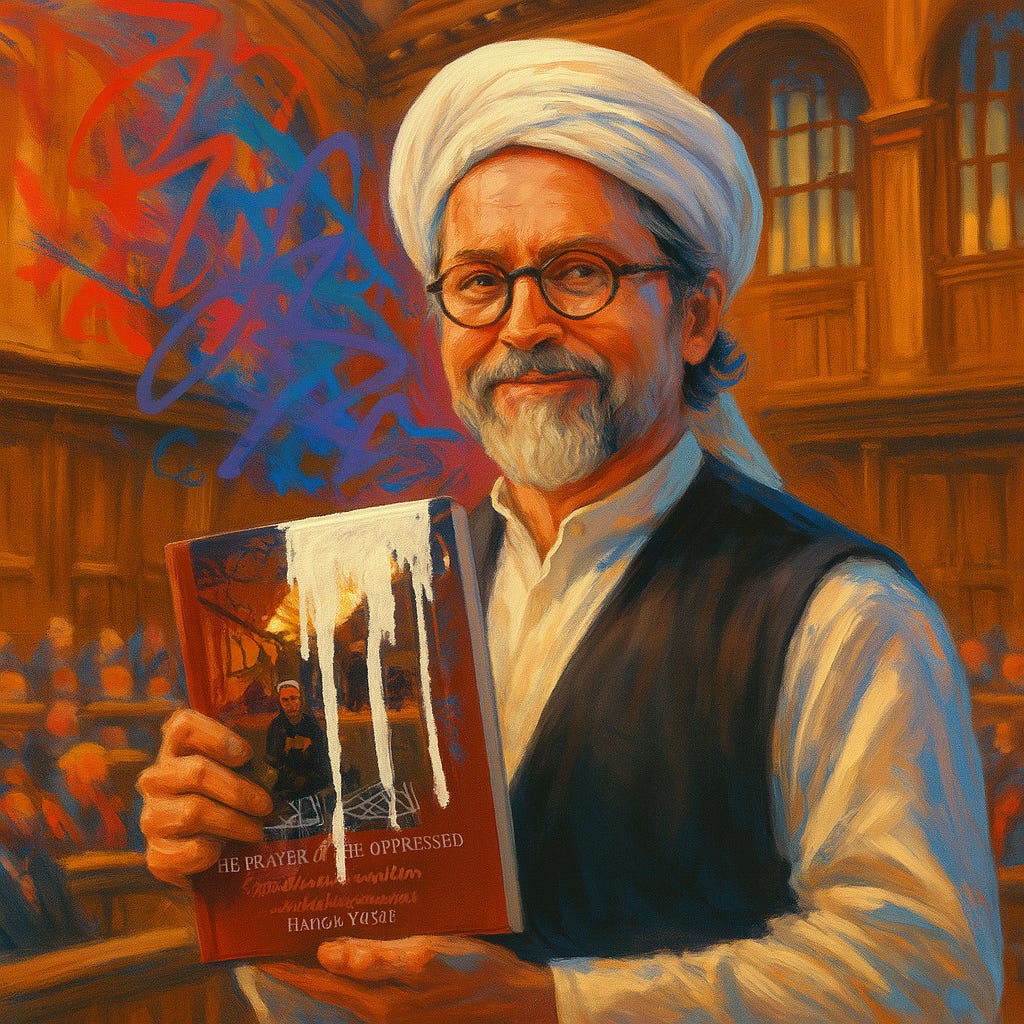
Part Two: Duʿāʾ of the Deceived, the Dead and the Disciples
Memories, Performances, and the Colonization of Meaning

“You’ve been hoodwinked! You’ve been had! You’ve been took! You’ve been led astray, run amok! This is what they do!”

— Malcolm X, Message to the Grassroots, 1963

Share

Preface: When the Frame Becomes the Filter

Before the first line of Duʿāʾ al-Maẓlūmīn is even read, the reader is already being positioned.

Hamza Yusuf’s introduction to the prayer includes four quotes, one from the Qur’an, one from the Prophet ﷺ, and two from white Western thinkers (St. Augustine and Friedrich Nietzsche). At first glance, they appear reflective, even profound. But taken together, they reveal the deeper betrayal: a deliberate reorientation of the duʿāʾ away from resistance and toward restraint.

  • The Qur’anic verse (17:33) cautions against excess in vengeance, framing the prayer as a potential danger rather than a rightful cry for justice.

  • The hadith reminds us to limit hostility, suggesting that the oppressed should soften their stance in case their oppressors someday become beloved.

  • St. Augustine pathologizes hatred, prioritizing the emotional well-being of the oppressed over their liberation.

  • Nietzsche, who viewed moral protest as weakness, is invoked to imply that reactive emotion is a lower spiritual form.

This is not context.

This is containment.

None of these quotes speak to the world Imam al-Darʿī lived in, nor to the world the oppressed still endure. They do not name ẓulm. They do not affirm rage. They do not echo the Qur’anic imperative to stand with the maẓlūm against the ẓālim. Instead, they disarm the reader before the prayer begins.

This is how theological laundering works.

It does not explicitly censor the duʿāʾ.

It reframes it- quietly, elegantly, and devastatingly.

A prayer born in resistance is presented in the voice of appeasement.

The White Minbar™ doesn’t always distort with force. Sometimes it does so through footnotes, formatting, and framing devices that turn liberation into lamentation.

The duʿāʾ deserves better.

So do the people who still pray it.

Duʿāʾ of the Deceived and the Dead

A Liturgy of the Unacknowledged

The first part of this essay series was - The Day the Duʿāʾ Died…


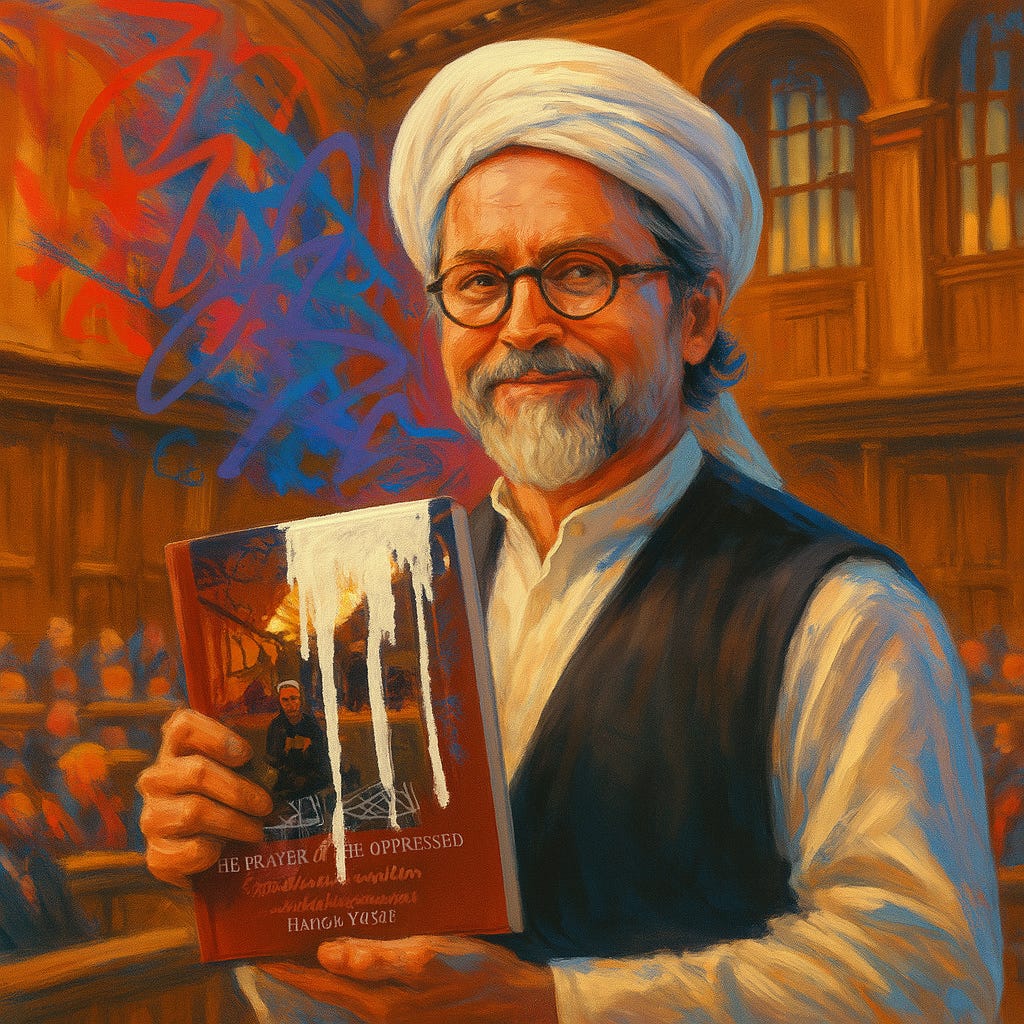
Just a few nights ago, I was going through my old collection of Islamic books—some packed away, some forgotten on a bottom shelf—and there it was: The Prayer of the Oppressed. I hadn’t touched it in years, but as soon as I saw the cover, that same feeling came rushing back. The unease. The grief. The betrayal I didn’t yet have language for. I held it in…

Read more

a month ago · 15 likes · 7 comments · Yusuf Jones


It was written in the wake of a realization. A reckoning with how a sacred invocation was not only appropriated, but hollowed out, softened, and returned to us shrouded in reverence and stripped of resistance.

But that was only part of the story.

Because what was done to Duʿāʾ al-Maẓlūmīn didn't begin with the release of a book. And it didn't end with weeping crowds and applause. For some of us, the betrayal had already happened, over and over, in other forms. It was already in our marrow, waiting for the next memory to make it hurt.

This part is not an analysis.

It's a memory.

A coming back.

A confrontation.

It's about what it feels like to watch the people revere the work but not the artist.

To honor the music of our living but silence the stories that made it so.

To sanctify the act while reassigning the humans.

This is the Duʿāʾ of the Deceived and the Dead, the liturgy of the unmarked, the overwritten, the staged, and the erased.

Prologue: 

I was about 13, on one of our yearly visits to Memphis and our genealogical trips to the plantation and surrounding areas of Grand Junction, Tennessee. We were visiting relatives and doing research at the Ames Plantation, one of the largest and most notoriously “preserved” plantations in the state. It was during one of their annual Field Days, a kind of open house that included agricultural exhibitions and curated cultural programming. At that time, part of their programming included a performance: a choir singing old spirituals and gospel songs, some of them drawn directly from slave narratives and oral histories collected on that very land.

Only the choir wasn’t made up of descendants. Not the ones I knew. Not any family I’d ever seen at the reunions or in the records. Two-thirds of them weren’t even Black. They were professionals, curated for harmony, for performance, for presentation. And I remember walking over, hearing the voices, recognizing the melodies from the very stories my father had collected. Songs of yearning. Songs of escape. Songs of divine deliverance. But sung with polish. Sung with uniformity. Sung without the blood memory that gave them weight.

Even without terminology and political education to define what was happening to me, I knew something was wrong. I had been helping my father to edit his slide presentation and oral history display, real names, real families, real histories of the people who had lived, suffered, prayed, and died on that plantation. I had heard the tapes. I had seen the pictures. I had seen my father haggle every year with the plantation committee about whether he would be "allowed" to perform, and where they would let him take up space. And every year, I watched them push him further from the center events. Further from the "celebration." Further from the soundtrack of survival.

That moment stayed with me. And when I opened that book years later, when I saw how Duʿāʾ al-Maẓlūmīn had been packaged, polished, and presented, when I saw people weeping over it while never once naming or even knowing (or wanting to know) the people whose oppression made it necessary…

I felt it again.

When I heard non-black people testifying about how it changed their lives, how it “resonated” with them, while I, most other Black people, and a few others who understood, winced, wondered, and quietly withdrew, it became painfully clear.

These were the same people who rolled their eyes when Black Muslims shared stories of police brutality and state executions.

The same people who sighed audibly whenever Black folks asked for space to build spiritual and cultural resistance movements, or dared to form coalitions that didn’t center whiteness or immigrant respectability politics.

The same people who, in private, warned Black Muslims not to “bring up race” at spiritual retreats—especially if the esteemed editor himself was going to be present. It was considered bad adab.

Even though they were, in a sense, also being misled by the same repackaging, they were mostly already willing to disregard Black people and deny Black realities. This book—and the spiritual theater surrounding it—just gave them a pious framework to explore and expand those escapist tendencies. It gave them permission to cry without listening, to reflect without remembering, to revere without reckoning.

It was a reversed Ratatouille moment. Not a flood of childhood joy, but a tightening of the chest. A heaviness that pressed in from memory. My heart didn’t have to travel far. As the erasures mounted and the performances multiplied—as the practiced piety escalated, each reading more stylized, each event more detached from struggle—it remembered.

My heart remembered every displacement.

Every time the story was told without the people.

Every time a sacred cry was recited with no intention of responding to its call.

And the more the editor revealed himself, the more he spoke, the more he rationalized, the more he positioned himself as both victim and guide, the deeper the wound became. His “complexity” wasn’t complexity at all. It was avoidance dressed as neutrality. It was privilege masked as spiritual maturity. It was complicity varnished with Arabic calligraphy.

This is what makes the betrayal so complete.

It wasn’t just about translation.

It was about transgression.

Suffering in Display Cases – The Aestheticization of Black Pain

They didn’t steal the story.

They just preserved it.

And that’s how you know it’s worse.

Because when a thing is preserved, it’s no longer dangerous. It’s been sanitized—removed from the rhythms of the living and encased in glass for study, admiration, or pity. The plantation did not just lie about the past. It curated it. And in doing so, it neutralized it.

What I witnessed on that Field Day was not just a performance, it was a ritual. A liturgy of acceptable memory. The songs were real. The history was real. The pain they referenced was real. But the way it was framed made it safe. Digestible. Harmonized. And above all—profitable.

This is how Black pain survives in white institutions:

It is displayed, not respected.

Performed, not answered.

Aestheticized, not addressed.

And Islamic institutions have not escaped this ritual. In fact, many have refined it.

In the masjid, we are allowed to talk about Black suffering only after it has become sentimental. The ancestors are invoked, but their demands are not. The enslaved are honored, but the systems they resisted are not named. Malcolm is quoted, but his rage is explained away. Our duʿāʾs are welcome, but only if they are metaphors—not manifestos.

Saidiya Hartman calls this the afterlife of slavery. A condition where Black existence is not merely post-trauma but structured by the denial of redress. Even when suffering is acknowledged, it is often done in ways that amplify spectacle while minimizing agency. This is what she terms “scenes of subjection”, performances of suffering that make the oppressed visible only as objects of pity, never as agents of revolution.

Christina Sharpe expands this in The Wake, where she describes the oceanic weight of Black loss, how it follows us like fog, like breath, like prophecy. She writes not of slavery as an event, but as a current—an ongoing force of erasure and misrepresentation. For Sharpe, remembrance without responsibility is violence. It masquerades as care but functions as control.

So when our pain is invited into the room—when it is quoted in lectures or recited before duʿāʾ—it is not proof of progress. It may be evidence of our continued exhibition.

This is why Duʿāʾ al-Maẓlūmīn was so easily reframed. It arrived into a world already fluent in curated Black grief. A world that knows how to display our cries without ever needing to respond to them…except with more violence.

Because to truly honor that prayer would require dismantling the systems that make it necessary.

To honor that prayer would mean interrogating power, not just mourning pain.

To honor that prayer would mean reckoning with the fact that many of those leading some institutions are more invested in preserving spiritual aesthetics than in pursuing divine justice.

And so instead, the prayer is preserved.

Like the slave cabins.

Like the songs.

Like the names carved into plaques but erased from authority.

Preservation is not always a blessing.

Sometimes, it’s a casket.

The Spiritual Cost of Dislocation

There are two categories we should talk in depth about now: the deceived, and the dead.

The deceived are not merely misinformed.

They are spiritually redirected, led to believe that performance is presence, that reverence is resistance, that aesthetic proximity to pain is the same as truth.

They are the ones who cry during readings of Duʿāʾ al-Maẓlūmīn, but recoil when Black Muslims name systems of oppression.

They swoon and marvel at plantation choirs, but do not ask who was denied the mic.

They praise our survival stories, but bristle at our demand for authority.

But deception isn’t always malicious. Sometimes it’s curated. Managed. Framed. The spiritual deception we speak of here is the kind that arises when memory is staged and grief is made palatable. When the pain of others becomes your spiritual exercise, but not your political commitment.

The deceived are lulled into thinking that to witness pain is enough. That to weep at oppression is a form of resistance. That feeling is the same as allyship and fidelity.

But the duʿāʾ is not meant to just be felt.

It is meant to be followed.

It is a declaration. A reckoning. A summoning of divine attention to injustice.

And when that duʿāʾ is presented without urgency, without context, without rage, it becomes a performance. And those who partake in it as performance are not just passive. They are misled. They become spiritual consumers, deceived into believing they have stood with the oppressed when all they’ve done is attend the pain.

And then there are the dead.

Not the biologically dead, but the spiritually displaced.

The prayers that were once weapons are now decorations.

The names of the oppressed are spoken, but their descendants are erased.

The cries are archived, footnoted, and formatted until they no longer scream.

These are the dead whose blood memory has been severed.

The ones whose stories are retold, but never by them.

The ones whose pain is quoted, but whose heirs are silenced.

The ones whose duʿāʾ is recited, but whose lineage is never restored.

When we lose the line between prayer and protest, we do not only lose history, we lose divine proximity. Because the Qur’an does not honor the oppressed in metaphor. It promises them victory. It aligns with them against tyrants. It calls for justice not after the fact, but as a condition of worship.

To forget this is to suffer a spiritual death. A soft fading of the fire that once lit the path between the crushed and the Creator.

This is why the curated duʿāʾ is so dangerous.

Because even as the pain is preserved, the power is dislocated.

Even as the words remain, the witness is gone.

Even as the tears fall, the reckoning never comes.

And so we are left with an archive of petitions, disconnected from the people who made them, and hollowed out by those who found them useful but not binding.

We must speak ever more urgently and clearly now.

Because to lose a connection to the duʿāʾ is not just to lose a ritual. It is to lose an axis of alignment with God. It is to lose a station of cosmic protest, a point of orientation that tethered the crushed directly to the All-Seeing. Without that connection, we drift, collectively, theologically, and historically, into a curated exile where grief is present but power is not.

And this exile is no accident.

It has architects.

The most dangerous distortions of our era do not arrive through brute force. They arrive through framingThrough scholars who dress betrayal in respectability. Through editors who redact confrontation and call it commentary. Through footnotes that function like chloroform, subduing the duʿāʾ, rendering it still, esculent, non-threatening.

Hamza Yusuf’s publication of Duʿāʾ al-Maẓlūmīn is not merely disappointing, it is a textbook case of Taghūtic laundering.

Not just because he introduced Western thinkers. Not just because he added commentary. But because he reconstructed the entire spiritual posture of the prayer, away from divine indictment and toward domesticated lament. He transformed the prayer’s intended alignment with the oppressed into a vague call for “restraint,” a gesture that, in effect, upholds the very structures of injustice the duʿāʾ was meant to defy.

This is not neutrality.

This is displacement with a prayer bead in hand.

He did not faithfully or fully transcribe or translate Imam al-Darʿī’s fire. He repackaged it. He smothered its flame beneath a quilt of pre-emptive forgiveness, misapplied mercy, and a dangerous preoccupation with the potential discomfort of the powerful. The maẓlūm becomes a poetic figure, not a witness in the court of the Most Just. And the ẓālim? He is not named. He is spiritualized. Absorbed into a cycle of moral abstraction so effectively that resistance itself becomes suspect.

This is not the Sunnah of the Prophet ﷺ.

This is not the duʿāʾ of Bilāl.

This is not the theology of the oppressed.

These are the disciples of the Madhab of the White Jesus™.

The builders of the White Minbar™.

The spiritual engineers of sanctified surrender.

They do not simply misinterpret the tradition.

They renovate it in their image.

They elevate restraint over justice, etiquette over alignment, and performance over prophetic fire.

They build platforms where whiteness is unspoken but central.

They publish prayers made inert.

They train followers to fear confrontation and call it spirituality.

They reward silence and brand it wisdom.

They erase the maẓlūm from the duʿāʾand replace them with an imagined self—wounded, reflective, emotionally moved, but never accountable.

This is not sacred transmission.

This is theological trespassing.

This is the Ṭarīqah of Ṭāghūt™.

A path disguised as piety.

A spirituality that protects oppressors by pacifying the oppressed.

A discipline of domesticated duʿāʾ and empire-friendly ethics.

And it is followed not only by the deceived, or the departed,

But by disciples who know exactly what they’re building.

Because they no longer tremble at injustice or before Divine balance and empathy.

Because they’ve confused reflection for resistance.

Hamza Yusuf did not dare kill the duʿāʾ.

He couldn’t.

But he embalmed it.

He placed it in a glass case and called it preservation.

He stripped it of its immediacy, its sacred ancestral legacy, its God-ordained resistance, and then handed it back to the community like a gift.

But it was a gift with the power and potency removed.

And that is not a gift.

That is desecration.

Performance of Reverence, Practice of Exclusion

It is one thing to betray a prayer.

It is another to build a platform around that betrayal.

What we face now is not merely a theological distortion, but an institutional choreography—a whole infrastructure of reverence that performs solidarity while enforcing exclusion. A system that honors the oppressed in word but refuses them voice, access, power, or presence.

This is not an accident.

It is design.

In this system, Black Muslims are welcome at the table, only if they don’t flip it over. They are featured in programs, invited to panels, asked to perform grief or forgiveness, but never given the authority to redefine the conversation. Never asked to lead the theological critique. Never trusted with the mic unless their words are already known to be safe.

This is how the White Minbar™ operates.

It invites proximity, but punishes the centering of the Prophetic.

It raises and amplifies voices that will not indict hatred of evil, but instead inspire erasure, displacement, and the denial of humanity.

It curates illusions and tokenizations of diversity to insulate against dissent, not to elevate truth.

It selects speakers who will leave power unnamed.

It rewards fluency in emotional resonance, but not in theological resistance.

You may be included, but only if you do not interrupt.

You may recite duʿāʾ, but not direct it.

You may recall suffering, but not issue summons against the systems and sycophants who prolong it.

This is not inclusion.

This is containment.

You can see it in the events where Duʿāʾ al-Maẓlūmīn is recited by candlelight but never connected to ICE raids, police killings, settler colonialism, or the surveillance of Muslim Black youth. You can feel it when Hamza Yusuf is flown in, again and again, to interpret a cry he helped neutralize, hosted not despite his distortion of the prayer, but because of it.

This is how reverence is weaponized.

Not to liberate.

To manage.

And this performance has its rules:

  • You may speak about pain, but not its political causes.

  • You may name trauma, but not name those who benefit from its ongoing erasure.

  • You may quote Malcolm, but only if you stop before he says “by any means necessary.”

  • You may invoke the Prophet ﷺ—but only the parts that can be read at interfaith banquets.

In this curated ecosystem, duʿāʾ becomes theater, and duʿāʾ leads become hosts. The ones who are permitted to teach the prayer are those who were never meant to inherit it. Those who once stood against this kind of spiritual betrayal now find themselves erased from their own traditions, or worse, invited only to play supporting roles on someone else’s stage.

And the stage is well-lit.

It includes:

  • Publishers who push the rebranded duʿāʾ while rejecting manuscripts and tafsir that name empire.

  • Institutions who ask Black Muslims to “speak about justice,” but edit the part where they indict the white supremacy of the institution itself.

  • Spiritual retreats where race is only and ever discussed after someone has been harmed, and even then, behind closed doors.

  • Conferences that host scholars who will lead aesthetically comforting discussions about anything but their performative piety.

  • Sacred poetry workshops that urge participants to the explore themes of Prophetic grief and loss without platforming those who have actually lost lives and been grieved by oppression.

  • Funders who will finance your grief, but never your resistance.

This is institutional Taghūt on a prayer rug.

This is spiritual apartheid in the age of curated inclusion.

This is how a prayer is domesticated by platforms that never intended to liberate—only to preserve power while appearing devout.

So when people ask,

“How could this prayer be betrayed?”

“How could so many accept the softened version?”

The answer is simple:

Because it was not just accepted.

It was platformed.

Promoted.

Packaged.

Endorsed.

Made respectable.

Because a prayer that indicts is a threat.

But a prayer that performs is an asset.

And in this system, spiritual assets are leveraged for likes, not liberation.

Revisiting the Introduction as a Quietist Framework for Spiritual Disarmament

If the curated epigraphs disarmed the reader’s heart before the prayer began, then Hamza Yusuf’s full introduction functions as a quietist sermon disguised as scholarship, a masterclass in literary incarceration that slowly shifts the purpose of the duʿāʾ from supplication against injustice to self-blame within injustice.

Let us be clear: what appears to be a deeply reflective essay on power, sin, and the nature of man is, in fact, a slow but deliberate displacement of the oppressed from the center of the prayer.

This is not an introduction.

It is a reframing.

A theological repositioning of who we are allowed to become when we open this book.

1. The Natural Order as Moral Template: From Resistance to Submission

The introduction begins by lauding the perfection of nature:

“Beasts of prey take only what they need to survive from weaker ones… all living together… in a world of harmony and mutual understanding.”

This is the first sleight of hand. It is the invocation of natural balance as moral baseline, used here to precondition the reader for a world where hierarchy is unproblematic as long as it reflects divine order.

In doing so, Yusuf implies that the real issue is deviation from divine symmetry, not systemic power. The world is good, he suggests, until man’s base desires distort it.

The problem is not oppression, then.

The problem is excess.

Once again, the lens is shifted inward before the reader even has a chance to hear the cry of the oppressed.

2. Sin as Universal Mirror: The Erasure of the Ẓālim-Maẓlūm Binary

This terribly Taghutic framework deepens with repeated claims that everyone is both oppressor and oppressed:

“A little bit of the tyrant exists in all of us.”

“We are all oppressors, and we are also oppressed.”

This reprehensible moral flattening, presented as spiritual introspection, is actually a systematic erasure of the Qur’anic binary between ẓālim and maẓlūm. Rather than affirming the sacred alignment with the crushed, Yusuf insists that we must first look inward to find our own complicity before speaking against injustice.

But this is not the method of the Qur’an.

The Qur’an names the tyrants.

The Qur’an sides with the oppressed.

The Qur’an reveals a divine preference—not neutrality.

By trying to make us all equally guilty, Yusuf neutralizes the duʿāʾ’s powerful moral trajectory. The prayer becomes a cracked mirror, not a shining sword.

The reader is not trained to join the oppressed, but to question whether they are allowed to critique at all.

3. Piety as Obedience; Never, Ever Confrontation

Throughout the introduction, Yusuf repeats the refrain of divine trust, submission, and the limits of critique:

“We are possessions of God, and one does not question the actions of any owner regarding his possessions.”

“We are not to object, only to understand.”

“Even in calamities, we must praise.”

But this is not how the Prophets ﷺ responded.

They wept.

They raised their hands.

They demanded.

They resisted Pharaohs, Nimrods, tyrants, and hypocrites.

Yusuf strips the duʿāʾ of its Qur’anic function as protest against injustice and replaces it with metaphysical acquiescence. The prayer no longer carries divine confrontation, it carries interior refinement. And that is the core of the betrayal.

This is not duʿāʾ as weapon.

This is duʿāʾ as therapy for privileged posturing.

4. Revenge, Resentment, and the Fear of Prophetic Rage

Perhaps the most revealing rhetorical device is Yusuf’s repeated pathologizing of anger:

“Revenge is a desire for healing.”

“Resentment is dissatisfaction with God.”

“Anger is a sign of spiritual immaturity.”

What, then, becomes of the maẓlūm who cries out in rage?

What becomes of the child who watches her father lynched, or the woman brutalized by occupation?

According to this framework, her rage is not sacred—it is suspect.

Her grief must be managed.

Her duʿāʾ must be contained.

And any desire for justice must be passed through a filter of personal purification before it is considered valid.

This is not mercy.

This is theological gentrification.

5. Prophetic Narratives Distorted by Quietism

Yusuf invokes the Prophet ﷺ again and again, but selectively. He emphasizes the Prophet’s patience, mercy, and refusal to curse, while omitting the Prophet’s rebuke of tyrants, prayers for divine punishment, and his sword unsheathed in the face of empire.

Nowhere does Yusuf mention:

  • The Prophet’s ﷺ explicit duʿāʾ against Qurayshi oppressors by name

  • His raising of arms against systematic violence

  • His refusal to spiritually normalize injustice through metaphysical surrender

Instead, the Prophet ﷺ is rendered as a figure of non-confrontational grace, a sage, not a statesman. The model given to the reader is not the Prophet of Uhud, Khandaq, or Fath Makkah, it is a Prophet carefully selected to support a theology of deference and domestication.

This is not Sunnah.

This is suppression in prophetic clothing.

6. The “Real Work” is Self-Blame

The final rhetorical manipulation is the most dangerous.

After three dozen pages, Yusuf ends by calling us away from structural analysis and into self-blame:

“If we find ‘other than good’ in the world, we are missing something fundamental to our faith.”

“We are the reason for the cycle of oppression.”

“We must purify our own souls before seeking justice.”

This is the replacement theology.

Where the Qur’an calls us to fight the ẓālim, this calls us to question our own audacity.

Where the Prophet ﷺ aligned with the downtrodden, this urges us to remain silent so as not to spiritually misstep.

Where duʿāʾ is supposed to shake the throne of oppression, this makes it a whisper in a mirror-lined room.

The final result?

A prayer with perfect Arabic.

A body of scholarly commentary.

A quiet heart.

And a silenced world.

The Hadith That Breaks the Frame

And yet, even after all the epigraphs, formatting, introductions, poetic gestures, citations, and moral detours—there remains one voice that none of it can drown out:

“Beware the duʿāʾ of the oppressed, for there is no barrier between it and Allah—even if the oppressed is a disbeliever.”

(Sahih narration; reported in Musnad Aḥmad, Bukhārī’s Adab al-Mufrad, and elsewhere)

There is no condition in this hadith.

No requirement for forgiveness.

No test of inner calm.

No purification of the soul.

No ideological checklist.

Not even explicit declarations of belief.

The cry of the oppressed does not ask for permission.

It does not wait for context.

It does not beg for literary framing.

It breaks through.

This is the terror Hamza Yusuf’s introduction sought to neutralize.

Because if this hadith is true—and it is—then everything his introduction constructed falls apart:

  • The restraint is irrelevant.

  • The spiritualized blame is irrelevant.

  • The literary elegance is irrelevant.

  • The metaphysical surrender is irrelevant.

The prayer does not need him.

The oppressed do not need him.

The duʿāʾ rises with or without editorial approval.

This single hadith, spoken from the mouth of the Messenger of God ﷺ, annihilates the entire architecture of curated patience and self-blame Hamza attempted to erect around the prayer.

This is the difference between the Prophetic tradition and its performance.

One empowers. The other polices.

One says: Cry out.

The other says: First, calm down.

But the Prophet ﷺ gave the maẓlūm no such warning.

He gave the ẓālim one:

“Beware…”

This is not commentary.

It is confrontation.

It does not ask you to reflect.

It demands that you listen.

And it does not speak to the oppressed.

It speaks to their oppressors—and to all who sanitize, explain away, or curate their pain.

This is the cry that Br. Mark Hanson tried to contain under the guise of Shaykh Hamza.

Not with erasure, but with elegance.

Not with censorship, but with serenity.

Not by denying the duʿāʾ- but by redefining what makes it worthy.

And so we say, now and finally:

  • We reject that frame.

  • We reject the footnotes and formatting.

  • We reject the literary polishing of a divinely directed scream.

  • We reject the demand for politeness before pain.

  • We reject the theology that places purity before protest, and self-blame before sacred confrontation.

This prayer was never meant to be beautiful.

It was meant to be heard in heaven.

It was meant to terrify tyrants.

It was meant to threaten empires.

It was meant to break hearts—and open the sky.

The duʿāʾ of the maẓlūm does not ask to be refined.

It asks to be remembered.

Rejoined.

Resurrected.

It was never dead.

Only buried under layers of literary performance, spiritual self-policing, and a refusal to trust the scream of the crushed.

But the duʿāʾ remembers itself.

It remembers Us.

It carries the voice of every child whose mother’s wails were ignored.

Every father disappeared behind bars.

Every ancestor left in the sea with no grave but the memory of the angels.

Every lineage stripped of the right to cry aloud.

We say to those who perform reverence while enforcing exclusion:

You cannot contain this cry.

You cannot control what heaven already hears.

You cannot manage what the Prophet ﷺ warned you about.

You cannot curate divine wrath.

You cannot rewrite a duʿāʾ that was never yours.

So we unarchive it.

We speak it without restraint.

We place the maẓlūm back at the center—not just as a victim, but as the rightful inheritor of prophetic proximity.

We say:

This prayer does not belong to publishers.

This prayer does not belong to platforms.

This prayer does not belong to polite religion.

This prayer belongs to those who cried it first, and those who still cry it now.

And we, we who descend from the drowned, the disappeared, the displaced, the defiant—

We are its heirs.
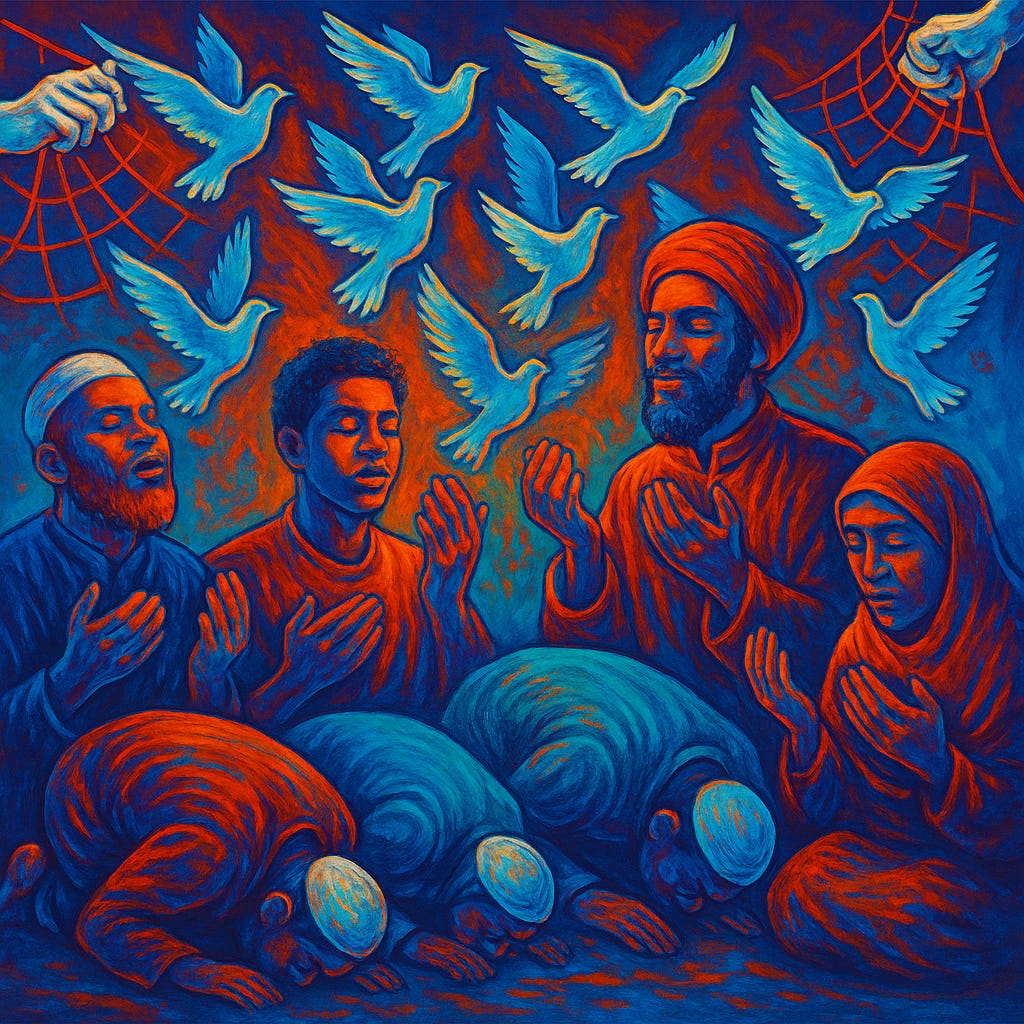


Epilogue: Toward Reclamation

What you’ve read is not the end of the duʿāʾ’s betrayal.

It is the naming of the betrayal.

And naming is only the first act of justice.

What comes next is not a response to Hamza Yusuf.

It is a response to God—to the sacred legacy of duʿāʾ as a weapon of the oppressed, as a trust handed down through pain, blood, and revelation.

Part Three will not be polite.

It will not offer compromise.

It will not ask permission.

It will reclaim the duʿāʾ in the name of those it was stolen from.

It will restore the voice of Imām Muḥammad b. Nāṣir al-Darʿī to its proper station—not as a spiritual ornament, but as a descendant of divine rage and resistance.

And it will do what the White Minbar™ fears most:

Reject the framing. Reassert the fire. Restore the lineage.

The duʿāʾ of the oppressed is not up for reinterpretation.

It is up for return.

We are not asking for space.

We are taking back the voice.

The next chapter is not about what they did.

It is about what we do now.

Share

  ☆Tadabbur Kalamullah 19 Rabiul Akhir 1447H☆ هَـٰۤأَنتُمۡ هَـٰۤؤُلَاۤءِ حَـٰجَجۡتُمۡ فِیمَا لَكُم بِهِۦ عِلۡمࣱ فَلِمَ تُحَاۤجُّونَ فِیمَا...